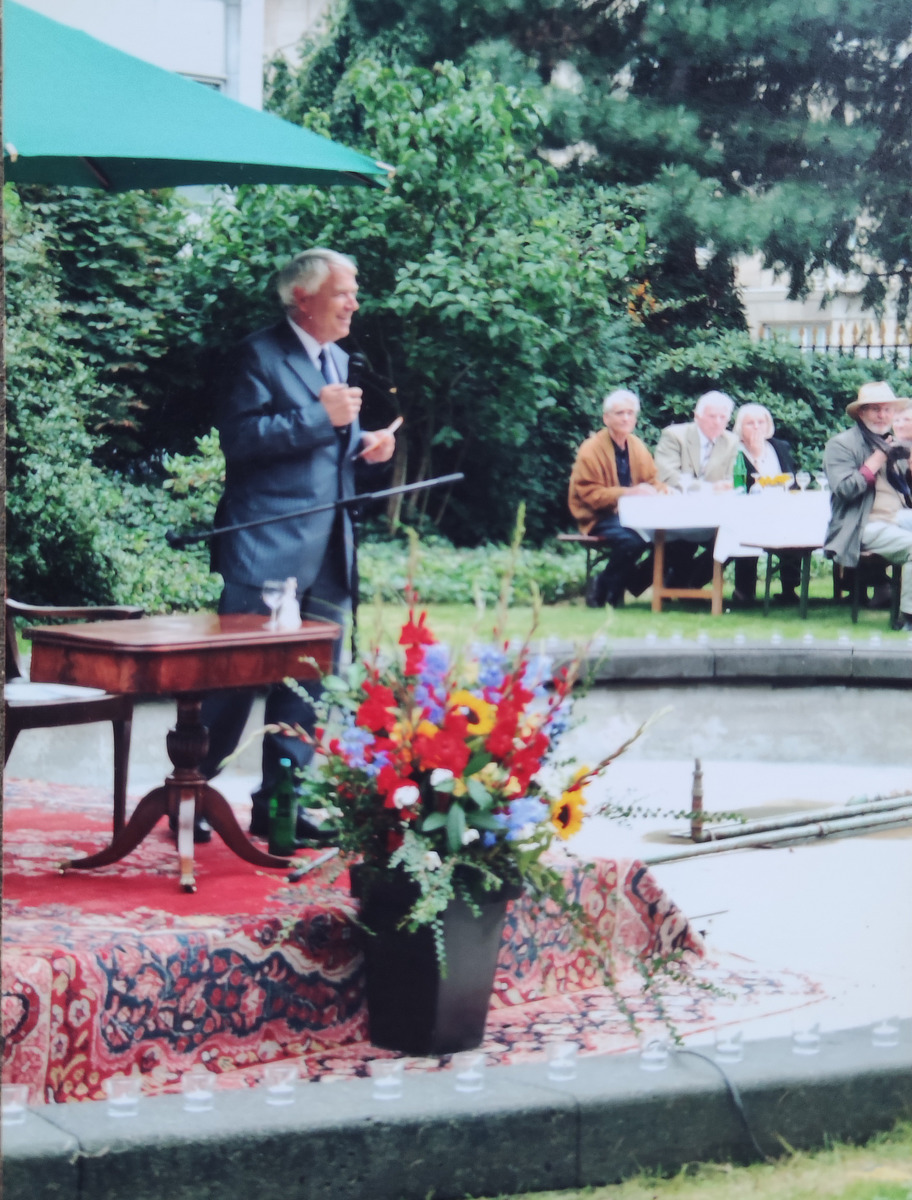
Prof. Dr. Dr. h.c. mult. Volkmar Hansen
Director of the Goethe Museum, Düsseldorf
Originally written in German. English translation.
“Goethe’s fascination with and appreciation of Greek Antiquity are summed up in his phrase, ‘The ultimate product of a continuously evolving nature is the beautiful human being.’ This could equally serve as the signature of Maria’s art.
‘Seeking the land of the Greeks with the soul,’ the poet writes in Iphigenia. Contemplating the images of Maria Alexea, one feels this longing intensely—a longing that Goethe elsewhere defines as a universal and existential yearning for the Homeland, meaning ancient Greece: the unique place in history where human existence assumed a humanistic form.”
Bia Papadopoulou
Art Historian and Curator · Former General Secretary of AICA Hellas, the Greek section of the International Association of Art Critics · President of AICA Hellas, 2018
Originally written in Greek. English translation.
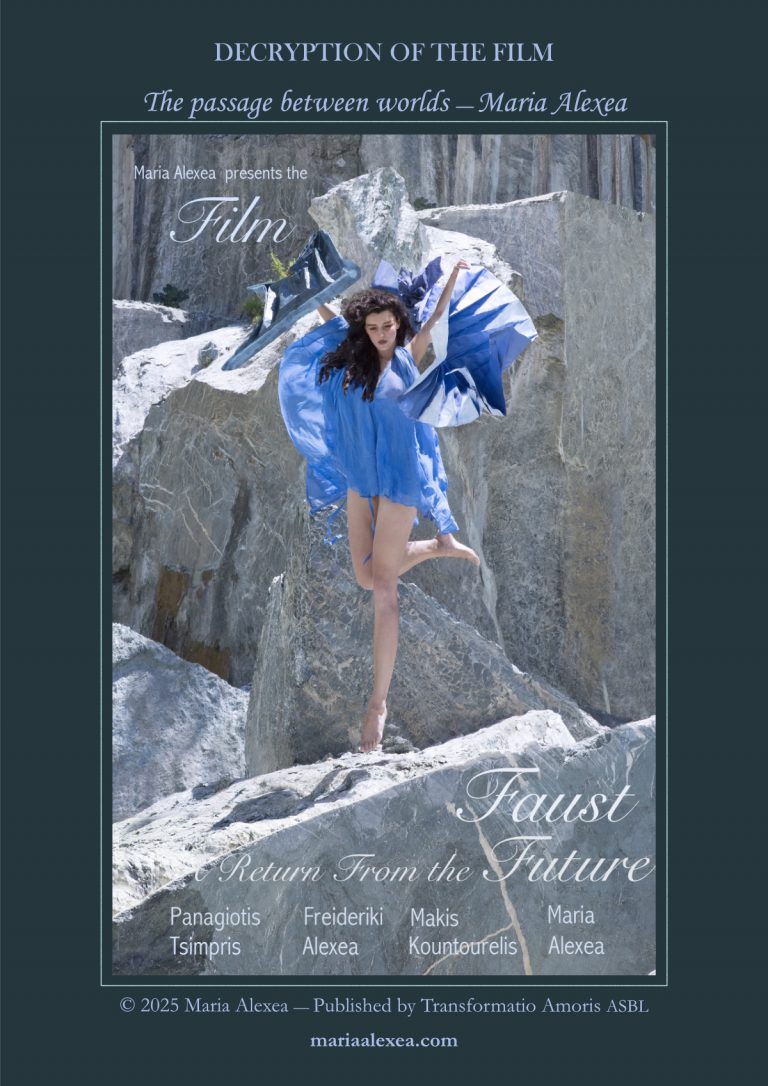
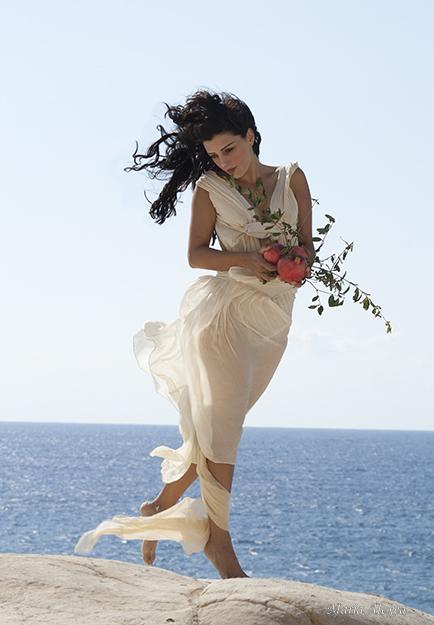
In Maria Alexea’s photographic compositions, reconstructed fragments of the real world form a singular hyperreality that emanates the timeless spirit of an idealised Hellas. As the director, choreographer and photographer of herself, the artist immerses herself in the process of artistic creation, thus experiencing, in succession, all the stages involved in the unification of art and life.
The archaeological sites of Greece are transformed into imaginary theatrical stages. They become the setting for Alexea’s dance, captured by a camera that she herself positions in selected places and at selected moments, carefully planning each photograph.
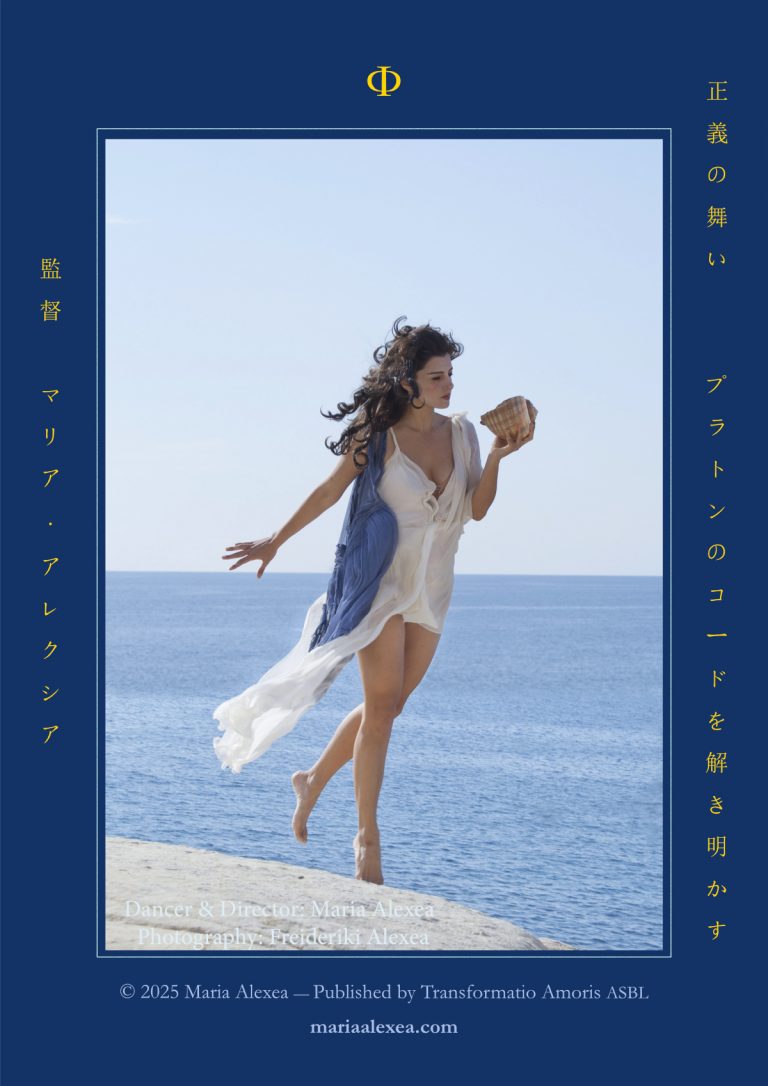
Like a contemporary Isadora Duncan, Alexea employs her body language with rhythm and freedom beneath the harshness of the Greek sun, which traces every curved line with clarity. The ancient ruins and the natural environments she chooses inspire her, allowing her choreographic and conceptual imagination to unfold further through improvisation.
In absolute harmony and dialogue with her surroundings, the artist—most often dressed in a white tunic, barefoot or wearing sandals—is perpetually transforming herself.
She embodies natural forces, Greek gods, goddesses and nymphs. The repertoire is rich, as the titles of the works reveal, including, among others, Wind and Fire, Prometheus, Icarus, Zephyrus, North Wind, Diana, Aphrodite, Hermes and Dryads.
The narrative, with its constant allusions to Greek myths and its use of metaphor and personification, becomes an allegory. Symbols—most often fragments of the Greek earth—contribute to the decoding of the roles named in the titles.
The transparent robe that the artist waves becomes not only a structural device but also an interpretative tool. Swirled by the wind together with the corresponding movements of the dancing body, the robe forms ethereal configurations, like paintings created with a single brushstroke in the air. These configurations, in turn, merge organically and finally become one with the white rocks and clouds, or magically transform into divine winds.
Seeking to transcend the finite nature of human existence, Alexea dances on tiptoe at the limits of extreme and dangerous circumstances.
She challenges her limitations both bodily and existentially. Thus, besides being the protagonist, she also becomes an observer and detective of her own “transformed” ego, embarking upon an arduous journey of self-knowledge.
The photographs of lived experiences and solitary wanderings along the pathways of time are transmuted into raw material, which the artist develops further with the aid of the computer in order to arrive at the final artistic result.
The world that she has painstakingly composed is then decomposed, so that its fragments may be resynthesised into a new imaginary story filled with wonder and unexpected transpositions.
Alexea breaks apart and reconstructs photographic documents in order to create, with the aid of electronic media, plastic images that interweave reality with its likeness. Fragments of different places, viewpoints and moments merge harmoniously within a single composition, creating hyperreal spaces that deliberately appear, for the most part, entirely real.
The unreal element is sometimes overt. It manifests itself chiefly through the symbolic flying apparition of Maria Alexea as a kind of anthropomorphic “divine being”.
These photocollages prompt the viewer to wonder whether the artist is playing with visual perception, seeking in some way to deceive both mind and eye. This uncertainty drives the viewer to roam visually through the works, to plunge into the hyperreal spaces of historical memory and, ultimately, to determine what is truth and what is falsehood.
Through their structure, the works of Maria Alexea bring to light the hidden geometry that governs nature and, at the same time, evoke, through association, the Pythagorean musical harmony of the universe.
The process followed by the artist—the process of creation, destruction and reconstruction—refers semantically to the philosophical conception of Heraclitus and to the perpetual cycle of life, birth, death and rebirth.
The reconstructed fragments of lived experience form an illusory, constructed wholeness that celebrates the cosmic equilibrium existing within ceaseless motion.
Monica Lacomy Ehrhardt
Prima Ballerina in the German Democratic Republic · Writer and President of the Delphic Council
Originally written in German. English translation.
“Exceptional photographs—compositions of apparent weightlessness and light, set within an atmosphere of Greek Antiquity. Beautiful as a freshly blossoming flower.
Yet they are more than beautiful: they embody the concentrated spiritual and cultural heritage of Greek Antiquity, brought to life with such vitality that they remain indelibly imprinted upon the viewer’s eye.”
Georg Albrecht
Art Theorist and Historian
Originally written in German. English translation.
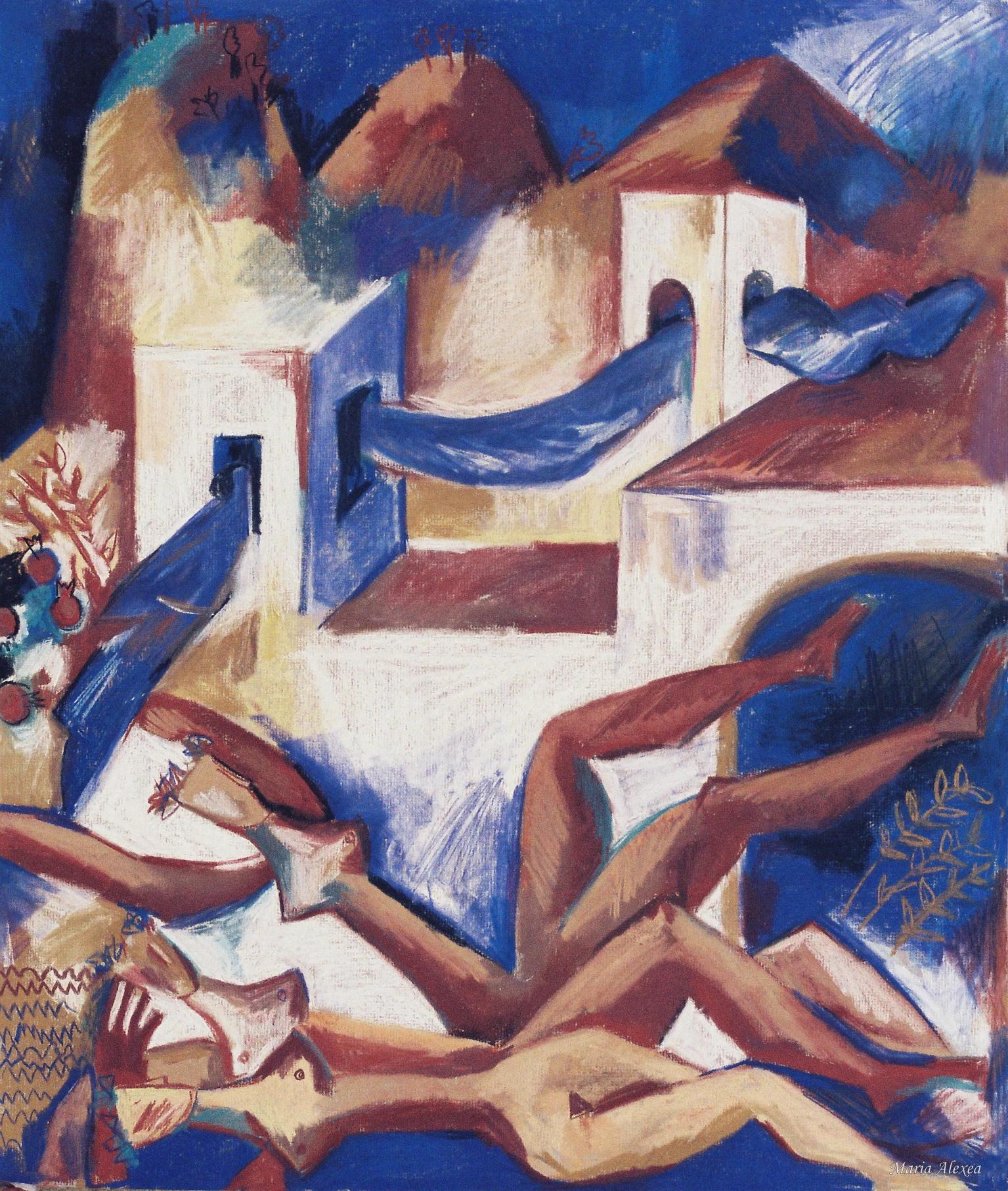
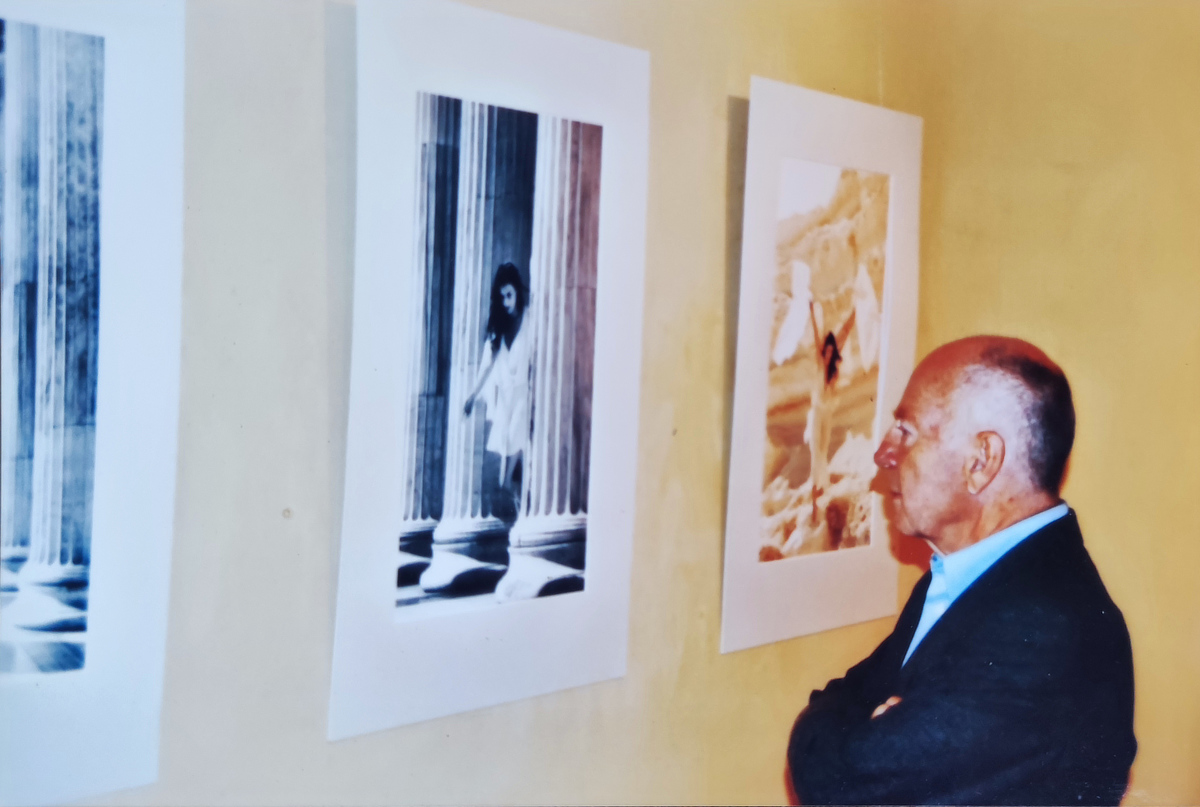
“The painting Awakenings displays an aesthetic unity of colours. Its theme could be interpreted as a representation of the struggle between sudden phenomena of violence inherent in life—a violence present throughout the entire course of human and natural history—and the equally powerful opposite forces that they provoke and which ultimately prevail.
It is the struggle and victory of mind and will that Beethoven celebrated in his Fifth Symphony.
Moreover, the interpretation of this painting may rely on the secondary representations that constitute the whole. There, the impenetrable azure sky and the surrounding barren hills seem intent on subordinating and constricting the luminous town rising within them.
At the same time, a dynamic and hopeful storm of winds—expressed, as in other parts of the painting, through a masterful repetition of colour—enters unexpectedly, breathing into the lungs of the white city the power of optimism, with the purpose of taming the threat.
The theme of the painting integrates itself with a feast of activated, frieze-like movements, which the vigorous wind brings to the lethargic, sensual female bodies celebrated throughout the centuries.
These are bodies of strength, like life in its glorious youth, which the painter Maria has surrounded with slender, dignified forms and artfully delicate flowers.
Thus, another interpretation could present the subject of the painting as an aesthetic apotheosis of the Aegean Sea, akin to that found in the national symbolic vocabulary of the Nobel laureate Odysseas Elytis.”