
The Mystery of Seventeen — Excerpt from “The Dance of Justice Φ Decoding Plato”
Das Geheimnis der Siebzehn — Auszug aus „Der Tanz der Gerechtigkeit Φ Platon entschlüsseln“
Part V — The Mystery of Seventeen and the True Self
ENGLISH
This text is an excerpt from The Dance of Justice and is published here to give an impression of the book’s thematic and conceptual orientation.
At the heart of this law lies number. In the Epinomis (991b–c), Plato speaks of an oscillation between twelve (12) and six (6), mediated by eight (8) and nine (9). Their union gives seventeen (17) — the hidden measure of the dactylic hexameter, the cadence of the Syrtos: nine (9) steps forward to the right, eight (8) to the left — the palindromic swing of the twin selves embodied in motion.
In Homeric time, the chorus danced syllables as steps; in Bach’s chorales, rhythm generates harmony through the same architecture. Thus telos (end) becomes archē (beginning) — every end a return that is also renewal. The body advances eight (8) steps, circles nine (9), and within the interval of seventeen (17) rediscovers the tonic of the octave.
Here the Muses appear as mediations between higher and lower: they turn rhythm into remembrance, proportion into revelation. Choreia becomes the sacred aphormē — the anagrammatic twin of morphē — disclosing the mirror-coupling of phenomenon and being.
This conversion is governed by the Φ–Θ operator. Θ (Theta) marks the horizontal plane — the chorikon pedion (choral ground) — while Φ (Phi) is time as a spiral rising through it. Viewed from above, the helix inscribes a circle upon Θ; from the side, the same motion draws a wave — rhythm. Thus the semantic cluster thanatos / theos / theōmai names experiential states on the plane, while phthora and phthongos reveal Φ acting upon Θ: time shaping space into measured order.
Within this law, pre-text becomes form, time becomes measure, and measure becomes remembrance — the anō mnēmē, the higher memory.
Choreia is not ornament. It is ontological law — the reuniting of the double self in time, the bridge of memory between the visible and the invisible. To dance is to remember, to heal the fracture, to reunite what has been split. In the circle of the Muses, the human being remembers its form and re-enters the harmony of the cosmos.
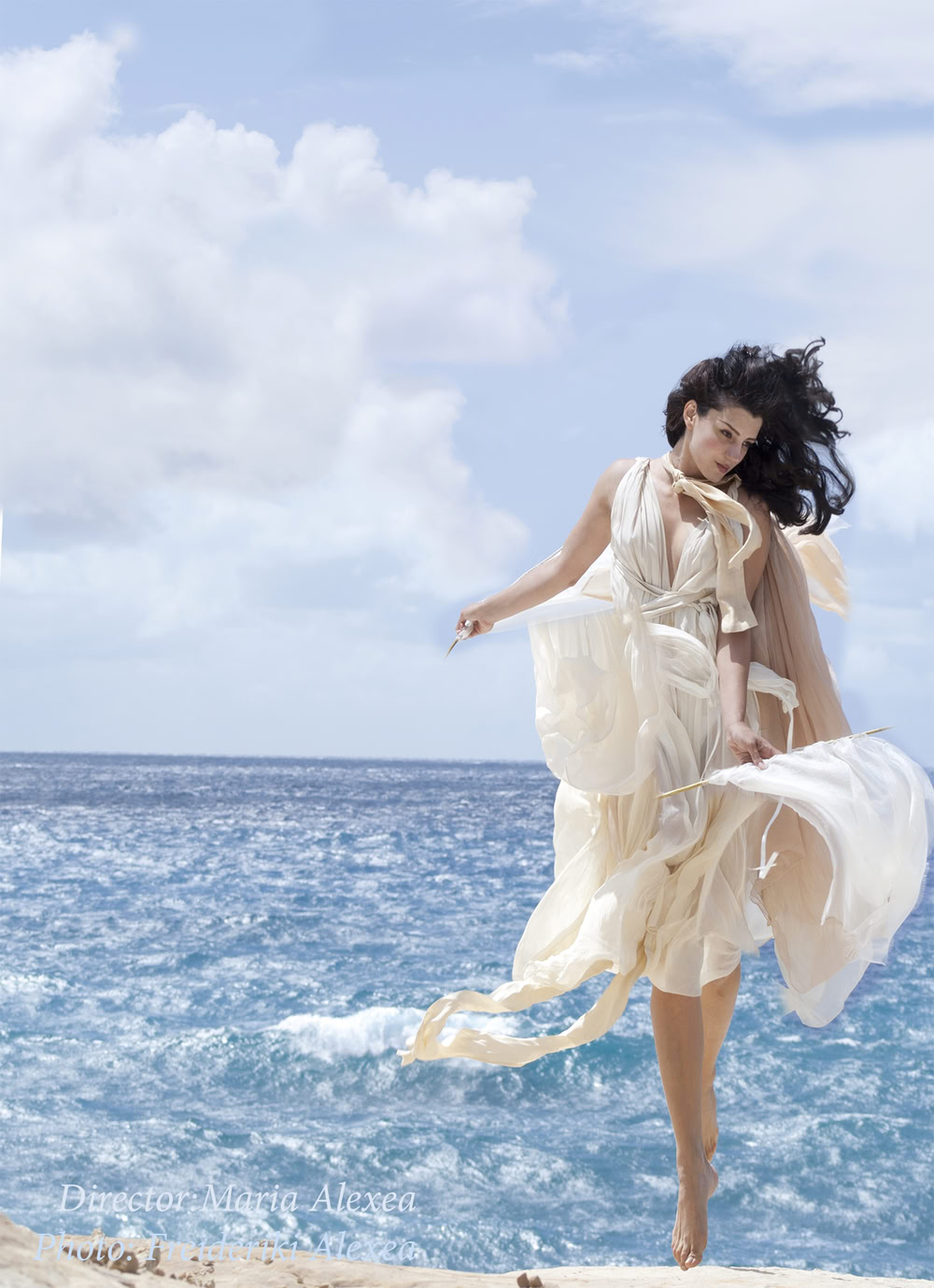
My photographs are a living representation of the threshold of seventeen (17) — spatially, because the dance takes place on liminal cliffs; temporally, because while the body moves forward into the future, the head gazes back toward the past, which is reclaimed through the living motion of Φ. The producer — the seventh (7) degree — leads to the tonic of the octave (7 + 1 = 8), but in an expanded field, through centrifugal unfolding. This is why Bach’s fugue is called a “fugue” (flight): it gives musical form to this centrifugal expansion of rhythm into space.
Maria Alexea
DEUTSCH
Dieser Text ist ein Auszug aus Der Tanz der Gerechtigkeit und wird hier veröffentlicht, um einen Eindruck von der thematischen und konzeptuellen Ausrichtung des Buches zu vermitteln.
Im Zentrum dieses Gesetzes steht ἀριθμός (Zahl). In der Epinomis (991b–c) spricht Platon von einer Schwingung zwischen δώδεκα (zwölf) und ἕξι (sechs), vermittelt durch ὀκτώ (acht) und ἐννέα (neun). Ihre Vereinigung ergibt ἑπτακαίδεκα (siebzehn / 17).
Diese Siebzehn (17) ist das verborgene Maß des daktylischen Hexameters, die Kadenz des Συρτός (Syrtos): neun (9) Schritte nach rechts, acht (8) nach links — die palindromische Schwingung des Doppel-Selbstes in der Bewegung verkörpert.
In der homerischen Zeit tanzte der Chor die Silben wie Schritte; das Wort war mit dem Körper verbunden. In den Chorälen Bachs entsteht die Harmonie aus dem Rhythmus in derselben architektonischen Ordnung. So wird τέλος (Ende) zu ἀρχή (Anfang): jedes Ende ist Rückkehr und Erneuerung. Der Körper schreitet acht (8) Schritte voran, kreist neun (9), und in der Spaltung der Siebzehn (17) findet er die Tonika der Oktave.
Hier erscheinen die Μοῦσαι (Musen) als μεσότητες (Mittlerinnen) zwischen Höherem und Niederem. Sie verwandeln Rhythmus in Erinnerung, Proportion in Offenbarung. Χορεία wird zur heiligen ἀφορμή (ersten Impuls) — einem anagrammatischen Zwilling der μορφή (Form). Das Sichtbare und das Wirkliche spiegeln sich umgekehrt: der verborgene Impuls entfaltet sich als Form, und die geformte Gestalt sät den Impuls von Neuem aus.
Dieses Gesetz wird vom Φ–Θ-Operator regiert: Θ (Theta) bezeichnet die horizontale Ebene — das χορικὸν πεδίον (chorisches Feld) — während Φ (Phi) die Zeit ist, die sich wie eine Helix durch sie erhebt. Von oben gesehen zeichnet die Helix einen κύκλος (Kreis) auf Θ; von der Seite betrachtet beschreibt sie eine κύμα (Welle) — ῥυθμός (Rhythmus). So markiert das semantische Bündel θάνατος (Tod) / θεός (Gott) / θεῶμαι (schauen) die Zustände der Ebene, während φθορά (Verwandlung) und φθόγγος (Ton) das Wirken von Φ durch Θ offenbaren — die Zeit formt den Raum zur gemessenen Ordnung.
Innerhalb dieses Gesetzes wird das Vorgegebene zur Form, die Zeit zum Maß, und das Maß zur Erinnerung. Χορεία ist kein Ornament — sie ist ein ontologisches Gesetz: die Wiedervereinigung des doppelten Selbstes in der Zeit, die Brücke der Erinnerung zwischen Sichtbarem und Unsichtbarem. Zu tanzen bedeutet, sich zu erinnern, die Spaltung der Amnesie zu heilen und das Getrennte neu zu verbinden. Im Kreis der Μοῦσαι erinnert der Mensch seine Form und kehrt in die Harmonie des Kosmos zurück.
Maria Alexea
Part V — The Mystery of Seventeen and the True Self
ENGLISH
This text is an excerpt from The Dance of Justice and is published here to give an impression of the book’s thematic and conceptual orientation.
At the heart of this law lies number. In the Epinomis (991b–c), Plato speaks of an oscillation between twelve (12) and six (6), mediated by eight (8) and nine (9). Their union gives seventeen (17) — the hidden measure of the dactylic hexameter, the cadence of the Syrtos: nine (9) steps forward to the right, eight (8) to the left — the palindromic swing of the twin selves embodied in motion.
In Homeric time, the chorus danced syllables as steps; in Bach’s chorales, rhythm generates harmony through the same architecture. Thus telos (end) becomes archē (beginning) — every end a return that is also renewal. The body advances eight (8) steps, circles nine (9), and within the interval of seventeen (17) rediscovers the tonic of the octave.
Here the Muses appear as mediations between higher and lower: they turn rhythm into remembrance, proportion into revelation. Choreia becomes the sacred aphormē — the anagrammatic twin of morphē — disclosing the mirror-coupling of phenomenon and being.
This conversion is governed by the Φ–Θ operator. Θ (Theta) marks the horizontal plane — the chorikon pedion (choral ground) — while Φ (Phi) is time as a spiral rising through it. Viewed from above, the helix inscribes a circle upon Θ; from the side, the same motion draws a wave — rhythm. Thus the semantic cluster thanatos / theos / theōmai names experiential states on the plane, while phthora and phthongos reveal Φ acting upon Θ: time shaping space into measured order.
Within this law, pre-text becomes form, time becomes measure, and measure becomes remembrance — the anō mnēmē, the higher memory.
Choreia is not ornament. It is ontological law — the reuniting of the double self in time, the bridge of memory between the visible and the invisible. To dance is to remember, to heal the fracture, to reunite what has been split. In the circle of the Muses, the human being remembers its form and re-enters the harmony of the cosmos.
My photographs are a living representation of the threshold of seventeen (17) — spatially, because the dance takes place on liminal cliffs; temporally, because while the body moves forward into the future, the head gazes back toward the past, which is reclaimed through the living motion of Φ. The producer — the seventh (7) degree — leads to the tonic of the octave (7 + 1 = 8), but in an expanded field, through centrifugal unfolding. This is why Bach’s fugue is called a “fugue” (flight): it gives musical form to this centrifugal expansion of rhythm into space.
Maria Alexea
DEUTSCH
Dieser Text ist ein Auszug aus Der Tanz der Gerechtigkeit und wird hier veröffentlicht, um einen Eindruck von der thematischen und konzeptuellen Ausrichtung des Buches zu vermitteln.
Im Zentrum dieses Gesetzes steht ἀριθμός (Zahl). In der Epinomis (991b–c) spricht Platon von einer Schwingung zwischen δώδεκα (zwölf) und ἕξι (sechs), vermittelt durch ὀκτώ (acht) und ἐννέα (neun). Ihre Vereinigung ergibt ἑπτακαίδεκα (siebzehn / 17).
Diese Siebzehn (17) ist das verborgene Maß des daktylischen Hexameters, die Kadenz des Συρτός (Syrtos): neun (9) Schritte nach rechts, acht (8) nach links — die palindromische Schwingung des Doppel-Selbstes in der Bewegung verkörpert.
In der homerischen Zeit tanzte der Chor die Silben wie Schritte; das Wort war mit dem Körper verbunden. In den Chorälen Bachs entsteht die Harmonie aus dem Rhythmus in derselben architektonischen Ordnung. So wird τέλος (Ende) zu ἀρχή (Anfang): jedes Ende ist Rückkehr und Erneuerung. Der Körper schreitet acht (8) Schritte voran, kreist neun (9), und in der Spaltung der Siebzehn (17) findet er die Tonika der Oktave.
Hier erscheinen die Μοῦσαι (Musen) als μεσότητες (Mittlerinnen) zwischen Höherem und Niederem. Sie verwandeln Rhythmus in Erinnerung, Proportion in Offenbarung. Χορεία wird zur heiligen ἀφορμή (ersten Impuls) — einem anagrammatischen Zwilling der μορφή (Form). Das Sichtbare und das Wirkliche spiegeln sich umgekehrt: der verborgene Impuls entfaltet sich als Form, und die geformte Gestalt sät den Impuls von Neuem aus.
Dieses Gesetz wird vom Φ–Θ-Operator regiert: Θ (Theta) bezeichnet die horizontale Ebene — das χορικὸν πεδίον (chorisches Feld) — während Φ (Phi) die Zeit ist, die sich wie eine Helix durch sie erhebt. Von oben gesehen zeichnet die Helix einen κύκλος (Kreis) auf Θ; von der Seite betrachtet beschreibt sie eine κύμα (Welle) — ῥυθμός (Rhythmus). So markiert das semantische Bündel θάνατος (Tod) / θεός (Gott) / θεῶμαι (schauen) die Zustände der Ebene, während φθορά (Verwandlung) und φθόγγος (Ton) das Wirken von Φ durch Θ offenbaren — die Zeit formt den Raum zur gemessenen Ordnung.
Innerhalb dieses Gesetzes wird das Vorgegebene zur Form, die Zeit zum Maß, und das Maß zur Erinnerung. Χορεία ist kein Ornament — sie ist ein ontologisches Gesetz: die Wiedervereinigung des doppelten Selbstes in der Zeit, die Brücke der Erinnerung zwischen Sichtbarem und Unsichtbarem. Zu tanzen bedeutet, sich zu erinnern, die Spaltung der Amnesie zu heilen und das Getrennte neu zu verbinden. Im Kreis der Μοῦσαι erinnert der Mensch seine Form und kehrt in die Harmonie des Kosmos zurück.
Maria Alexea
Loading comments…