
Το Ουράνιο Φυτό — Οι Διαιρέσεις, οι Αντεστραμμένες Περιφορές και η Επανόρθωση κατά τον Πλάτωνα
The Heavenly Plant — Divisions, Reversed Revolutions and Restoration According to Plato (Gr-En)
📖 Book
«The Dance of Justice Φ — Decoding Plato»
Άρθρο (Ελ)
Η γεωμετρία της πτώσης, ο ανάποδος κόσμος και η επιστροφή στην αρχαία φύση
Μαρία Αλεξέα
Εισαγωγή — Ο άνθρωπος που λησμόνησε τον προσανατολισμό του
Τι σημαίνει να βρίσκεται ο άνθρωπος όρθιος; Αρκεί η κατακόρυφη στάση του σώματος απέναντι στη γη ή υπάρχει μια βαθύτερη, πρωταρχική σχέση που καθορίζει τον αληθινό προσανατολισμό του;
Ο Πλάτων, στον Τίμαιο, περιγράφει τον άνθρωπο ως «φυτὸν οὐκ ἔγγειον ἀλλὰ οὐράνιον». Η ρίζα του δεν βρίσκεται στα πόδια του αλλά στην κεφαλή, η οποία συνδέεται με την ουράνια συγγένεια της ψυχής.
Αυτή η διατύπωση αποκτά ιδιαίτερη σημασία όταν συνδεθεί με άλλα χωρία του ίδιου διαλόγου, στα οποία περιγράφονται η διαίρεση της κοσμικής ψυχής, η διασταύρωση των κινήσεων, η ανατροπή των περιφορών, η αντιστροφή του δεξιού και του αριστερού και, τελικά, η δυνατότητα επανόρθωσης.
Δεν έχουμε επομένως μόνο μια εικόνα του ανθρώπου ως ουράνιου φυτού. Έχουμε μια ολόκληρη κοσμολογική και ανθρωπολογική προβληματική γύρω από τη μορφή, την κίνηση, τη διαίρεση, τον προσανατολισμό και την αποκατάσταση της αρχικής τάξης.
Στην παρούσα μελέτη εξετάζω τα πλατωνικά χωρία παράλληλα με τη δική μου έρευνα για τη γεωμετρία της μορφής και τη Χορεία του Φ. Ορισμένες μορφικές αντιστοιχίες του ελληνικού αλφαβήτου χρησιμοποιούνται ως ανεξάρτητες γεωμετρικές παρατηρήσεις και όχι ως ετυμολογικές αποδείξεις ή ως διδασκαλία που αποδίδεται στον Πλάτωνα.
Το ερώτημα είναι συγκεκριμένο: μπορεί η πτώση να νοηθεί ως διαίρεση και μεταβολή προσανατολισμού, και η επανόρθωση ως ανάκτηση της ορθής σχέσης των μερών με την πρωταρχική ενότητα;
I. Η διαίρεση και το τρίτο που συγκροτεί την ενότητα
Στον Τίμαιο 35a, ο Πλάτων περιγράφει τη σύνθεση της ψυχής του κόσμου. Ο Δημιουργός συνδυάζει το αμέριστο, που παραμένει πάντοτε κατά τον ίδιο τρόπο, με το μεριστό, που σχετίζεται με τα σώματα, σχηματίζοντας μια τρίτη ενδιάμεση ουσία.
Η διαδικασία δεν σταματά στην αντιπαράθεση δύο στοιχείων.
«ἐκ τριῶν ποιησάμενος ἕν».
Τίμαιος, 35a.
Από τα τρία δημιουργεί ένα.
Αυτό είναι ουσιώδες: το τρίτο δεν αποτελεί περιττή προσθήκη σε δύο ήδη ολοκληρωμένες πραγματικότητες. Συμμετέχει στη συγκρότηση της ενότητάς τους.
Η σχέση συνδέεται με την αρχή που έχει προηγουμένως διατυπωθεί στον Τίμαιο 31c: δύο στοιχεία δεν μπορούν να συνδεθούν καλώς χωρίς ένα τρίτο, έναν δεσμό που τα συναρμόζει μέσω αναλογίας.
Η μεσότητα δεν εξαφανίζει τις διαφορές. Επιτρέπει να αποτελέσουν στοιχεία μιας ενιαίας σύνθεσης.
Στη δική μου οντολογική ανάγνωση, αυτή η αρχή είναι καθοριστική. Το πρωτότυπο και η εκδηλωμένη μορφή δεν μπορούν να θεωρηθούν δύο απολύτως αποκομμένες ουσίες. Η μεταξύ τους σχέση προϋποθέτει έναν ενεργό δεσμό. Χωρίς αυτόν, δεν υπάρχει ζωντανό Όλον, αλλά δύο αφαιρέσεις που αδυνατούν να αναγνωρίσουν την κοινή τους καταγωγή.
Ο Πλάτων όμως προχωρεί ακόμη περισσότερο. Η ενότητα, αφού συγκροτηθεί, υποβάλλεται σε διαίρεση σύμφωνα με αριθμητικές σχέσεις. Δεν έχουμε μια άμορφη ενότητα, αλλά μια σύνθεση που αποκτά εσωτερικές αναλογίες.
Η διαίρεση, επομένως, δεν είναι από μόνη της πτώση ή καταστροφή. Μπορεί να είναι δημιουργική πράξη, όταν διατηρεί τον δεσμό και την αρμονία.
Η καταστροφή αρχίζει εκεί όπου η σχέση των μερών διαταράσσεται.
II. Το Χ της κοσμικής ψυχής — Τομή, διασταύρωση και κυκλική κίνηση
Στον Τίμαιο 36b–c συναντούμε μία από τις πιο ενδιαφέρουσες γεωμετρικές περιγραφές του διαλόγου.
Αφού ολοκληρώσει την αριθμητική και αρμονική διάρθρωση της κοσμικής ψυχής, ο Δημιουργός διαιρεί την όλη σύνθεση κατά μήκος σε δύο λωρίδες, τις διασταυρώνει στο μέσον και κατόπιν τις κάμπτει κυκλικά, συνδέοντας τα αντίστοιχα άκρα.
Ο Πλάτων χρησιμοποιεί ρητά το γράμμα Χ για να περιγράψει τη διασταύρωση:
«διπλῆν κατὰ μῆκος σχίσας […] οἷον χεῖ προσβαλὼν».
Τίμαιος, 36b–c.
Διαίρεση κατά μήκος — διασταύρωση σαν Χ — κάμψη και κυκλική σύνδεση.
Δεν πρόκειται εδώ για μια αυθαίρετη αλφαβητική αναλογία. Η μορφή του Χ κατονομάζεται μέσα στην ίδια την πλατωνική κοσμολογική κατασκευή.
Από αυτή τη διαδικασία προκύπτουν δύο κυκλικές περιφορές: η εξωτερική, που αντιστοιχεί στη φύση του Ταὐτοῦ, και η εσωτερική, που αντιστοιχεί στη φύση του Θατέρου.
Ο Πλάτων διαφοροποιεί επίσης την κατεύθυνσή τους: η μία περιφέρεται προς τα δεξιά και η άλλη προς τα αριστερά. Η περιφορά του Ταὐτοῦ διατηρείται αδιαίρετη, ενώ η άλλη υποδιαιρείται περαιτέρω σε επτά άνισους κύκλους.
Εδώ συνυπάρχουν η ενότητα και η διαίρεση, η δεξιά και η αριστερή φορά, ο κοινός δεσμός και η διαφοροποίηση των περιφορών.
Η γεωμετρία δεν λειτουργεί ως εξωτερικός στολισμός της κοσμολογίας. Αποτελεί μέρος της περιγραφής του τρόπου με τον οποίο η ψυχή του κόσμου αποκτά δομή και κίνηση.
Αυτό έχει ιδιαίτερο ενδιαφέρον για την έρευνά μου: η αρχική ενότητα δεν παύει να υπάρχει επειδή αποκτά διακεκριμένες κινήσεις. Το ουσιαστικό ερώτημα είναι αν αυτές οι κινήσεις διατηρούν τη μεταξύ τους αναλογία.
III. Η γένεση και ο άνθρωπος του ανεστραμμένου κόσμου
Στον Τίμαιο 43a–e, η περιγραφή μεταφέρεται στην κατάσταση της ψυχής όταν συνδέεται με το θνητό σώμα.
Ο Πλάτων μιλά για τις περιόδους της αθάνατης ψυχής που δένονται μέσα σε ένα σώμα υποκείμενο σε εισροές, εκροές και εξωτερικές επιδράσεις. Οι σωματικές κινήσεις προκαλούν βίαιες διαταραχές.
Το ζωντανό ον κινείται ατάκτως προς έξι κατευθύνσεις: εμπρός και πίσω, δεξιά και αριστερά, κάτω και άνω.
Δεν πρόκειται για την αρμονική διαφοροποίηση της κοσμικής σύνθεσης, αλλά για την αναστάτωση των περιφορών της ψυχής από τις δυνάμεις της σωματικής γένεσης.
Οι αναλογίες και οι δεσμοί των κύκλων δοκιμάζονται. Οι περιφορές παραμορφώνονται και αδυνατούν να κινηθούν σύμφωνα με την αρχική τους τάξη.
Ο Πλάτων τις περιγράφει να κινούνται:
«τοτὲ μὲν ἀντίας, ἄλλοτε δὲ πλαγίας, τοτὲ δὲ ὑπτίας».
Τίμαιος, 43e.
Άλλοτε αντίθετα, άλλοτε πλάγια, άλλοτε ανάποδα.
Και αμέσως προσφέρει ένα συγκεκριμένο παράδειγμα: έναν άνθρωπο με την κεφαλή στη γη και τα πόδια στραμμένα προς τα άνω. Σε αυτή τη θέση, το δεξί και το αριστερό παρουσιάζονται αντιστραμμένα σε σχέση με τον προσανατολισμό του παρατηρητή.
Ο Πλάτων περιγράφει την αντιστροφή όχι μόνο ως μεταβολή της κίνησης αλλά και ως μεταβολή της αντίληψης του προσανατολισμού.
Εδώ βρίσκεται ο πυρήνας του προβλήματος του ανάποδου κόσμου.
Όταν οι εσωτερικές περιφορές έχουν διαταραχθεί, το ον εξακολουθεί να κινείται. Δεν έχει χάσει τη δυνατότητα κίνησης. Έχει χάσει την ορθή σχέση των κινήσεών του.
Αυτή η διάκριση είναι θεμελιώδης.
Ένας κόσμος μπορεί να εμφανίζει συνεχή δραστηριότητα, διαδοχή μορφών και αδιάκοπη κίνηση χωρίς οι κινήσεις αυτές να αποτελούν εκδήλωση αρμονικής συγκρότησης.
Η κινητικότητα δεν ισοδυναμεί αναγκαστικά με εξέλιξη. Η πολλαπλότητα δεν ισοδυναμεί αναγκαστικά με ενότητα.
Και η αντιστροφή του προσανατολισμού δεν καταργεί την αρχική γεωμετρία. Μεταβάλλει τη σχέση του όντος με αυτήν.
IV. Όταν το ανεστραμμένο παρουσιάζεται ως αληθινό
Στον Τίμαιο 44a, ο Πλάτων προχωρεί από την περιγραφή της κίνησης στην περιγραφή της γνώσης.
Οι διαταραγμένες περιφορές οδηγούν σε λανθασμένες κρίσεις για το Ταὐτόν και το Θάτερον.
Χρησιμοποιεί τη χαρακτηριστική διατύπωση:
«τἀναντία τῶν ἀληθῶν».
Τίμαιος, 44a.
Τα αντίθετα από τα αληθινά.
Δεν πρόκειται πλέον μόνο για το σώμα που εμφανίζεται ανάποδα ή για τις κινήσεις που αλλάζουν κατεύθυνση. Η διαταραχή φτάνει μέχρι την ίδια τη δυνατότητα διάκρισης της αλήθειας.
Αυτό που υφίσταται εξωτερική επιβολή μπορεί να θεωρεί ότι κυριαρχεί, ενώ στην πραγματικότητα κυριαρχείται. Οι αισθητηριακές εντυπώσεις μπορούν να συμπαρασύρουν τις κινήσεις της ψυχής.
Η ανεστραμμένη κατάσταση τείνει έτσι να παρουσιάζεται ως κανονικότητα.
Σε αυτή την πλατωνική προβληματική διακρίνω μια ουσιαστική βάση για τη φιλοσοφική διερεύνηση του παρὰ φύσιν πεδίου: όχι ως ενός κόσμου που στερείται οποιασδήποτε τάξης, αλλά ως μιας κατάστασης στην οποία η σχέση των κινήσεων με την αρχική τους φύση έχει διαταραχθεί.
Ο άνθρωπος μπορεί να προσαρμόζεται σε αυτή την κατάσταση και να την εκλαμβάνει ως τη μοναδική πραγματικότητα.
Έτσι η λήθη δεν είναι απλώς η απώλεια μιας παλαιάς ανάμνησης. Μπορεί να νοηθεί ως η αδυναμία αναγνώρισης του ίδιου του ορθού προσανατολισμού.
V. Η ορθή γωνία, η διαίρεση και τα γεωμετρικά σχήματα του αλφαβήτου
Η πλατωνική περιγραφή μάς επιτρέπει να θέσουμε ένα ανεξάρτητο γεωμετρικό ερώτημα: ποιες πράξεις μπορούν να μεταβάλουν τον προσανατολισμό μιας μορφής διατηρώντας αναγνωρίσιμα στοιχεία της αρχικής της συγκρότησης;
Στη δική μου έρευνα εξετάζω ορισμένα γράμματα του ελληνικού αλφαβήτου ως σχήματα που μπορούν να υποβληθούν σε συγκεκριμένες γεωμετρικές πράξεις.
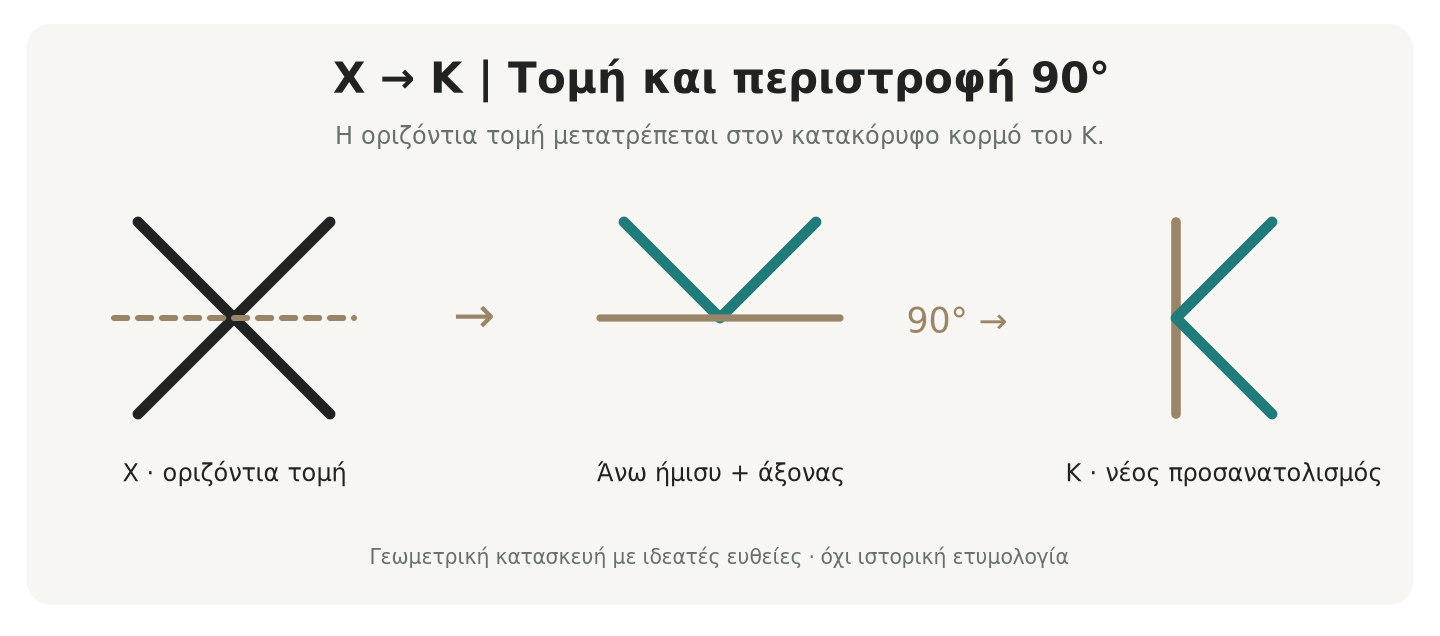
Στο Χ, μια οριζόντια τομή που διέρχεται από το σημείο διασταύρωσης διακρίνει δύο γωνιακά ημίση. Αν κρατήσουμε το άνω ήμισυ μαζί με τον άξονα της τομής και περιστρέψουμε την κατασκευή κατά 90 μοίρες, εμφανίζεται η γεωμετρική διάταξη του Κ. Ο προηγουμένως οριζόντιος άξονας γίνεται κατακόρυφος.
Η πράξη περιλαμβάνει τομή, επιλογή ημίσεος, περιστροφή και αλλαγή προσανατολισμού του άξονα.
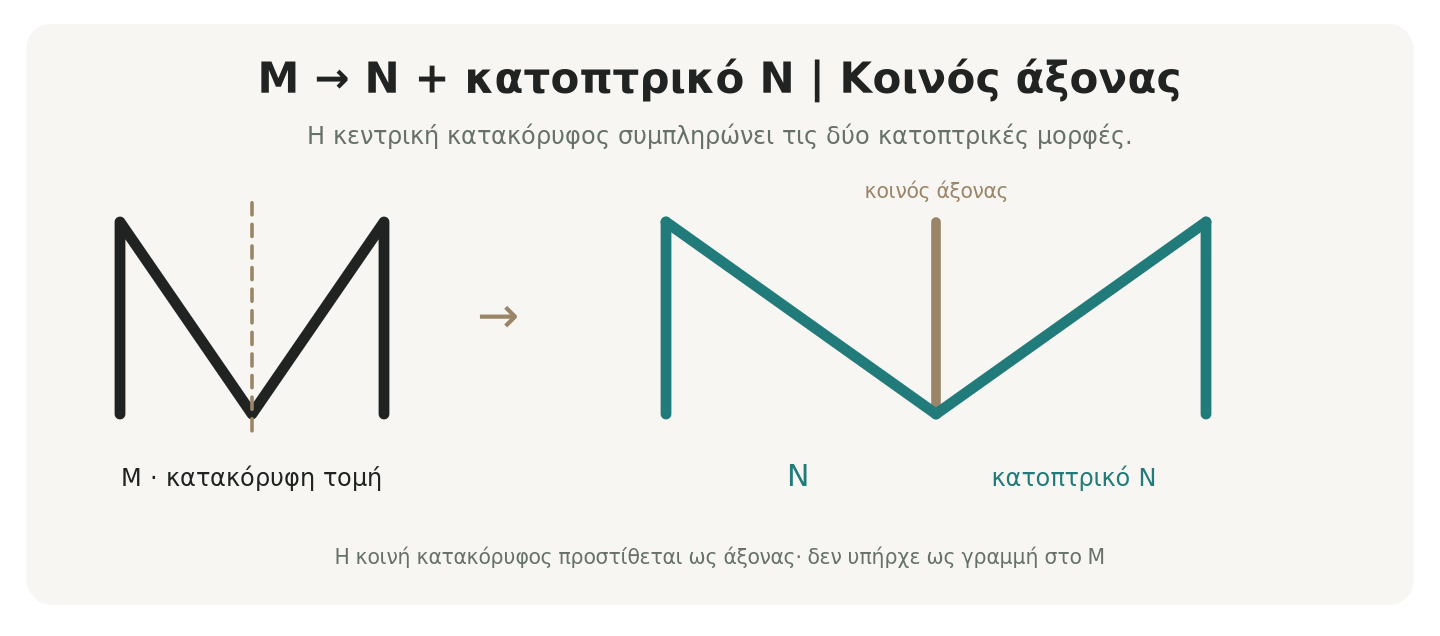
Στο Μ, μια κατακόρυφη τομή από το μέσον αποκαλύπτει δύο κατοπτρικές γωνιακές μορφές. Αν ο κοινός άξονας συμπληρώσει την καθεμιά, μπορούν να ανασυντεθούν ως Ν και κατοπτρικό Ν.
Εδώ η κρίσιμη πράξη δεν είναι η περιστροφή, αλλά η συμμετρική διαίρεση και η ανάδειξη ενός κοινού άξονα.
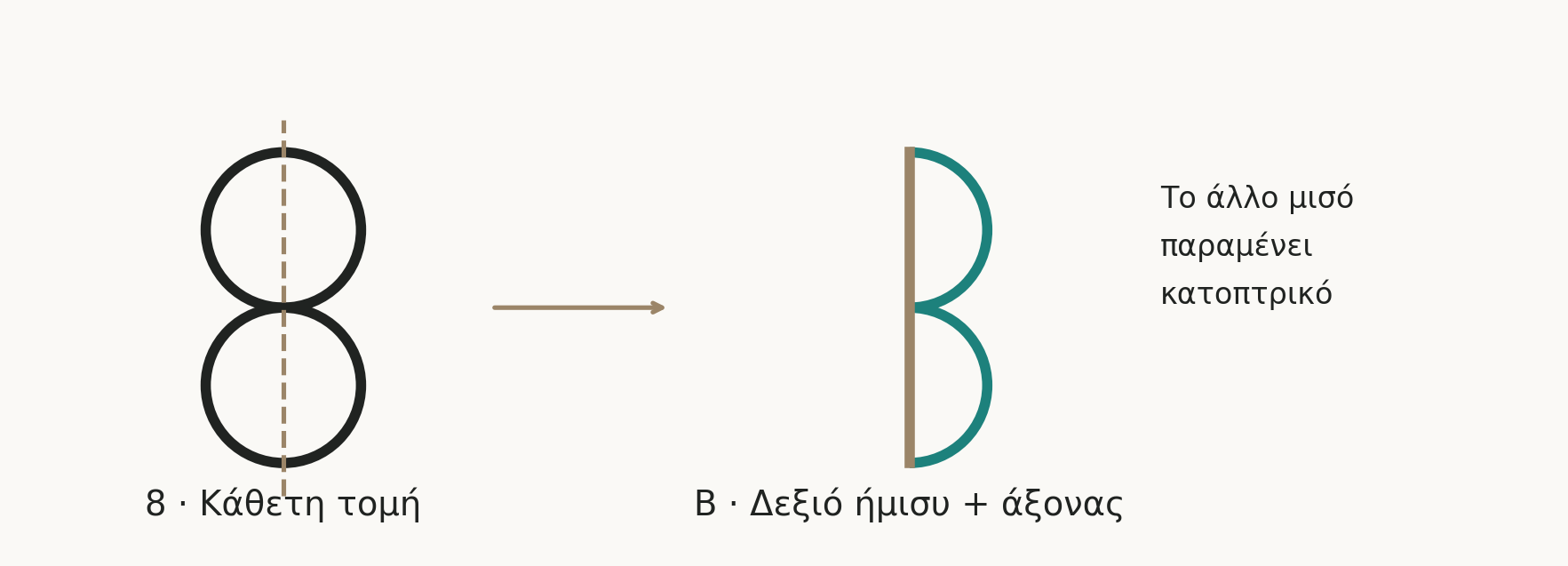
Στο Β μπορεί να εξεταστεί η σχέση του με το δεξί ήμισυ μιας συμμετρικής μορφής 8: δύο βρόχοι, μία κατακόρυφη τομή και ένας κοινός κορμός. Το 8, με τη σειρά του, προσφέρει ένα πρόσφορο σχήμα για τη μελέτη αντίρροπων βρόχων και της μεταξύ τους διασταύρωσης.
Η σχέση του με το Χ μπορεί να διερευνηθεί ως σχέση μεταξύ διασταυρούμενων διευθύνσεων και κλειστών τροχιών. Μια τέτοια αντιστοιχία απαιτεί όμως ορισμένη γεωμετρική κατασκευή· δεν παράγεται ένα 8 μόνο με την άκαμπτη περιστροφή του Χ.
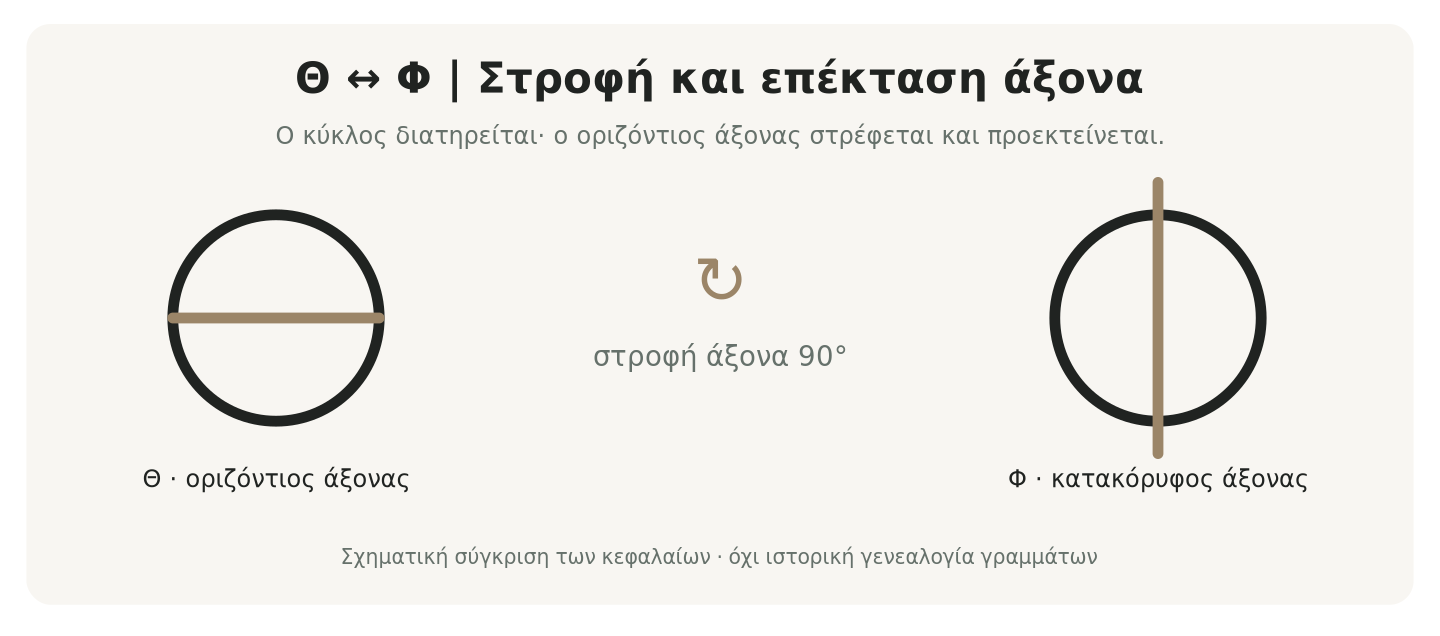
Τέλος, στη σχηματική σχέση Θ και Φ, ο κύκλος διατηρείται, ενώ ο εσωτερικός οριζόντιος άξονας μετατρέπεται σε κατακόρυφο και επεκτείνεται πέρα από την περιφέρεια.
Η ορθή γωνία, ως σχέση δύο καθέτων διευθύνσεων, αποκτά ιδιαίτερο ενδιαφέρον. Το Πυθαγόρειο θεώρημα θεμελιώνει τη σχέση των πλευρών του ορθογώνιου τριγώνου, ενώ μια περιστροφή 90 μοιρών μπορεί να μεταφέρει μια πλευρά από τον κατακόρυφο στον οριζόντιο άξονα χωρίς να μεταβάλει το μήκος της.
Αυτές οι πράξεις είναι γεωμετρικά ελέγξιμες. Δεν συνιστούν από μόνες τους απόδειξη ότι το αλφάβητο κατασκευάστηκε ως κρυπτογραφημένη κοσμολογία.
Στη δική μου υπόθεση λειτουργούν ως μορφικές παρατηρήσεις, με τις οποίες εξετάζεται αν οι έννοιες της διαίρεσης, της κατοπτρικής αντίθεσης, της αλλαγής φοράς και της ανασύνθεσης μπορούν να συγκροτήσουν συνεκτικό σύστημα.
Ο συμβολικός χαρακτηρισμός τους ως «παράφωνων» μορφών του αλφαβήτου αφορά ακριβώς αυτή τη δυνατότητα ανάγνωσης μιας μετασχηματισμένης, ενδεχομένως ανεστραμμένης διάταξης. Δεν πρόκειται για ιστορική ή γλωσσολογική κατηγορία.
Η σημασία της σύγκρισης με τον Τίμαιο βρίσκεται αλλού: ο Πλάτων περιγράφει πράγματι κοσμικές διαιρέσεις, διασταυρώσεις, αντίρροπες περιφορές και μεταβολές της τάξης των κινήσεων. Η αλφαβητική γεωμετρία αποτελεί τη δική μου παράλληλη απόπειρα σχηματικής διερεύνησης αυτών των σχέσεων.
VI. Η επανόρθωση — Από την αντιστροφή στο κατὰ φύσιν
Η πλατωνική αφήγηση δεν σταματά στη διαταραχή.
Στον Τίμαιο 44b–c, όταν οι περιφορές καταπραΰνονται, αρχίζουν να ανακτούν τη φυσική τους πορεία. Κατευθύνονται ξανά σύμφωνα με το σχήμα που αντιστοιχεί στη φύση τους και επιτρέπουν στον άνθρωπο να διακρίνει ορθά.
Ο Πλάτων συνδέει αυτή την αποκατάσταση με την παιδεία, την οποία αποκαλεί ορθή τροφή της ψυχής.
Η έννοια του ορθού εδώ δεν περιορίζεται στη σωματική στάση.
Ορθό είναι εκείνο που έχει αποκαταστήσει τη σχέση της κίνησής του με τη φύση που του αντιστοιχεί.
Η διαφορά είναι αποφασιστική.
Δεν αρκεί να συγκεντρωθούν δύο αποκομμένα μέρη. Εάν δεν αποκατασταθεί η μεταξύ τους ορθή σχέση, η συνάθροιση δεν αποτελεί αναγκαστικά επανένωση.
Αυτό το σημείο επιτρέπει τη διατύπωση της δικής μου γεωμετρικής υπόθεσης: η επανόρθωση μπορεί να εξεταστεί ως διαδικασία κατά την οποία προηγείται η διόρθωση της φοράς ή του προσανατολισμού και ακολουθεί η ανασύνθεση της μορφής σύμφωνα με τον κοινό της άξονα.
Ο Πλάτων δεν δίνει εδώ κάποια συγκεκριμένη γωνία περιστροφής των μερών. Περιγράφει όμως τη μετάβαση από τη διαταραγμένη κίνηση στην κατά φύσιν τάξη.
Η γεωμετρική μου διερεύνηση επιχειρεί να προσδιορίσει ποιες μορφικές πράξεις θα μπορούσαν να αναπαραστήσουν αυτή τη μετάβαση.
Έτσι η ανόρθωση δεν ταυτίζεται με μια εξωτερική αλλαγή στάσης. Είναι η επανάκτηση μιας εσωτερικής αρμονικής σχέσης.
VII. Το ουράνιο φυτό — Η ρίζα βρίσκεται άνω
Φτάνουμε τώρα στον Τίμαιο 90a–d.
Ο Πλάτων παρουσιάζει το κυριότερο μέρος της ανθρώπινης ψυχής ως θεϊκό δώρο, εγκατεστημένο στο άκρο του σώματος, και εξηγεί ότι συνδέει τον άνθρωπο με την ουράνια συγγένειά του.
«φυτὸν οὐκ ἔγγειον ἀλλὰ οὐράνιον».
Τίμαιος, 90a.
Και συνεχίζει:
«τὴν κεφαλὴν καὶ ῥίζαν ἡμῶν […] ὀρθοῖ πᾶν τὸ σῶμα».
Τίμαιος, 90a–b.
Η κεφαλή είναι η ρίζα. Η αναφορά στην ουράνια καταγωγή δεν λειτουργεί ως προσθήκη στην ανθρώπινη υπόσταση αλλά ως θεμελιώδης προϋπόθεση της όρθιας συγκρότησής της.
Το γεγονός αυτό αντιστρέφει τη συνηθισμένη εικόνα του γήινου φυτού.
Το γήινο δέντρο έχει τη ρίζα του κάτω και αναπτύσσεται προς τα άνω. Το πλατωνικό ουράνιο φυτό έχει τη ρίζα του άνω, ενώ το σώμα του εκτείνεται προς τη γη.
Η διαφορά δεν είναι μόνο τοπογραφική. Είναι οντολογική.
Στο βιβλίο μου Ο Χορός Νεμέσεως, αναπτύσσω τη σχέση ανάμεσα στο πρωταρχικό ουράνιο ον, τη γήινη εκδήλωσή του, τον Νοῦ και την ψυχή, μέσω της γεωμετρίας της Χορείας του Φ.
Υπό αυτό το πρίσμα, η αντιστροφή του ανθρώπινου προσανατολισμού μπορεί να ερμηνευθεί ως λήθη της πρωταρχικής ρίζας και ως ταύτιση της γήινης εκδήλωσης με το σύνολο της ύπαρξης.
Ο άνθρωπος θεωρεί ότι η αρχή του βρίσκεται εκεί όπου παρατηρεί την πρόσκαιρη μορφή του.
Αλλά ο Πλάτων μας καλεί να αναζητήσουμε την πρώτη γένεση της ψυχής αλλού.
Αυτός που καλλιεργεί αποκλειστικά τις επιθυμίες και τη φιλονικία ενισχύει, κατά τον Πλάτωνα, το θνητό μέρος του. Εκείνος που ασκεί τη φιλομάθεια και την αληθινή φρόνηση κατευθύνεται προς όσα είναι θεία και αθάνατα.
Το πρόβλημα δεν είναι η ίδια η ύπαρξη του σώματος ούτε η αναγκαία φυσική ζωή. Είναι η αντιστροφή της ιεραρχίας, όταν το μέρος που οφείλει να υπηρετεί παρουσιάζεται ως η ανώτατη αρχή.
Εδώ η έννοια του ανεστραμμένου κόσμου αποκτά ηθική διάσταση.
Ο άνθρωπος δεν παύει να αποτελεί ουράνιο φυτό επειδή προσανατολίζεται προς το επιθυμητικόν. Αλλά μπορεί να ζει σαν να έχει μεταφερθεί η ρίζα του στο κατώτερο πεδίο.
VIII. «Ἐξορθοῦντα» — Η επιστροφή στην αρχαία φύση
Στον Τίμαιο 90d, ο Πλάτων επιστρέφει στις περιφορές της ψυχής.
Καλεί τον άνθρωπο να μελετά τις αρμονίες και τις περιφορές του σύμπαντος και, μέσω αυτής της γνώσης, να επανορθώνει τις διαταραγμένες περιόδους της νόησής του.
Η καθοριστική λέξη είναι:
«ἐξορθοῦντα».
Τίμαιος, 90d.
Και ο σκοπός δηλώνεται με την έκφραση:
«κατὰ τὴν ἀρχαίαν φύσιν».
Δεν καλείται ο άνθρωπος να κατασκευάσει μια νέα, αυθαίρετη φύση. Καλείται να αποκαταστήσει τη σχέση του με την αρχαία φύση.
Το νοούν πρέπει να ομοιωθεί με το νοούμενο μέσω της κατανόησης της αρμονίας.
Αυτό είναι το βαθύτερο σημείο συνάντησης της πλατωνικής φιλοσοφίας με τη δική μου έρευνα.
Στον Τίμαιο 35–36 η ψυχή του κόσμου συγκροτείται με μεσότητες, αναλογίες, διαιρέσεις και περιφορές.
Στον Τίμαιο 43–44 οι περιφορές της ανθρώπινης ψυχής υφίστανται διαταραχή, αναστροφή και απώλεια του ορθού προσανατολισμού.
Στον Τίμαιο 90 η δυνατότητα αποκατάστασης συνδέεται με την ουράνια ρίζα, την αληθινή νόηση και τη γνώση της κοσμικής αρμονίας.
Οι τρεις αυτές περιοχές του διαλόγου συγκροτούν μια ουσιαστική φιλοσοφική ακολουθία.
Δεν περιγράφουν την ίδια πράξη σε κάθε σημείο. Η δημιουργική διαίρεση της κοσμικής ψυχής δεν ταυτίζεται με τη μεταγενέστερη διατάραξη των ανθρώπινων περιφορών. Ωστόσο, η μεταξύ τους σύγκριση αναδεικνύει ένα σταθερό ζήτημα: ποια σχέση επιτρέπει στα διαφορετικά μέρη και στις διαφορετικές κινήσεις να αποτελούν ένα αρμονικό Όλον;
Η επανόρθωση δεν είναι επιστροφή στην ακινησία. Είναι η αποκατάσταση της ορθής κίνησης.
Και η αρμονία δεν σημαίνει κατάργηση της διαφοράς. Σημαίνει διαφορά που έχει ανακτήσει τη σχέση της με την ενότητα.
IX. Επίλογος — Η γεωμετρία της επιστροφής
Η πτώση, στη φιλοσοφική ανάγνωση που προτείνω, δεν είναι αναγκαστικά μια απλή μετακίνηση από έναν υψηλότερο τόπο σε έναν χαμηλότερο.
Μπορεί να νοηθεί ως μεταβολή του προσανατολισμού της μορφής, διατάραξη των περιφορών και απώλεια της αναγνώρισης του πρωταρχικού άξονα.
Γι’ αυτό και η αποκατάσταση δεν περιορίζεται στην ανάκτηση ενός χαμένου τόπου. Προϋποθέτει αναγνώριση, επαναπροσανατολισμό και ανασύσταση της ορθής σχέσης.
Η γεωμετρική διερεύνηση των γραμμάτων Χ, Κ, Μ, Ν, Β, Θ και Φ αποτελεί ένα ανεξάρτητο πεδίο εξέτασης αυτής της υπόθεσης. Οι τομές, οι περιστροφές, οι κατοπτρισμοί και οι κοινοί άξονες δεν αποδεικνύουν από μόνοι τους μια αρχαία κρυφή διδασκαλία. Μπορούν όμως να αναδείξουν με σαφή, ορατό τρόπο τις πράξεις που χρησιμοποιούμε για να περιγράψουμε τη διαίρεση και την επανόρθωση.
Το ουσιώδες βρίσκεται στον Πλάτωνα.
Οι περιφορές μπορούν να αντιστραφούν. Η αντίληψη μπορεί να απομακρυνθεί από την αλήθεια. Ο άνθρωπος μπορεί να βρεθεί σε κατάσταση ασυμφωνίας με την αρχική του φύση.
Αλλά οι διαταραγμένες κινήσεις μπορούν και να επανορθωθούν.
Η ουράνια ρίζα δεν καταργείται από τη λήθη της.
Η επιστροφή, επομένως, δεν είναι η δημιουργία ενός άλλου ανθρώπου από το μηδέν. Είναι η ανάκτηση της σχέσης με εκείνο που ο άνθρωπος είναι κατά την πρωταρχική του φύση.
Το ουράνιο φυτό δεν χρειάζεται να μεταφυτευθεί στον ουρανό. Η ρίζα του βρίσκεται ήδη εκεί.
Αυτό που χρειάζεται να αποκατασταθεί είναι ο προσανατολισμός του.
Μαρία Αλεξέα
Πρωτογενείς πηγές και αναφορές
- Πλάτων, Τίμαιος, 31b–c — Ο τρίτος δεσμός και η αναλογία.
- Πλάτων, Τίμαιος, 35a–36d — Η σύνθεση της κοσμικής ψυχής, η διαίρεση, το Χ, οι κύκλοι του Ταὐτοῦ και του Θατέρου.
- Πλάτων, Τίμαιος, 43a–44c — Οι έξι κατευθύνσεις, οι διαταραγμένες περιφορές, η αντιστροφή, η λανθασμένη αντίληψη και η αποκατάσταση.
- Πλάτων, Τίμαιος, 90a–d — Το ουράνιο φυτό, η κεφαλή ως ρίζα, οι επιθυμίες, η νόηση και η επανόρθωση.
- Μαρία Αλεξέα, Ο Χορός Νεμέσεως, κεφάλαιο IV — Ο άνθρωπος ως ουράνιο φυτό, η ψυχή και ο Νοῦς σε σπειροειδή συνοχή.
Γεωμετρικά σχήματα της μελέτης: Χ → Κ, Μ → Ν και κατοπτρικό Ν, 8 → Β, Θ ↔ Φ. Πρόκειται για σχηματικές γεωμετρικές αναλύσεις της συγγραφέως, ανεξάρτητες από τη φιλολογική ερμηνεία των πλατωνικών χωρίων.
Article (En)
The geometry of the fall, the inverted world, and the return to the original nature
Maria Alexea
Introduction — The Human Being Who Forgot Their Orientation
What does it mean for a human being to stand upright? Is the body’s vertical posture in relation to the earth sufficient, or is there a deeper, primordial relationship that determines our true orientation?
In the Timaeus, Plato describes the human being as “φυτὸν οὐκ ἔγγειον ἀλλὰ οὐράνιον” — “a plant not of the earth but of heaven.” Our root is not located in our feet but in our head, which is related to the soul’s kinship with heaven.
This formulation acquires particular significance when it is read alongside other passages from the same dialogue, which describe the division of the World Soul, the intersection of motions, the disruption of revolutions, the reversal of right and left, and, ultimately, the possibility of restoration.
We therefore encounter more than an image of the human being as a heavenly plant. We encounter an entire cosmological and anthropological inquiry into form, motion, division, orientation, and the restoration of the original order.
In this study, I examine the Platonic passages alongside my own research into the geometry of form and the Choreia of Φ. Certain formal correspondences among letters of the Greek alphabet are presented as independent geometrical observations, not as etymological proofs or as teachings attributed to Plato.
The question is precise: can the fall be understood as a division and a change of orientation, and restoration as the recovery of the proper relationship of the parts to their primordial unity?
I. Division and the Third That Constitutes Unity
In Timaeus 35a, Plato describes the composition of the World Soul. The Demiurge combines the indivisible, which always remains in the same condition, with the divisible, which is associated with bodies, thereby forming a third, intermediate kind of being.
The process does not end with the opposition of two elements.
«ἐκ τριῶν ποιησάμενος ἕν» — “making one out of three.”
Timaeus, 35a.
He makes one out of the three.
This is essential: the third is not a superfluous addition to two realities that are already complete. It participates in the constitution of their unity.
This relationship recalls the principle Plato has already stated in Timaeus 31c: two things cannot be properly joined without a third, a bond that connects them by means of proportion.
The intermediate term does not abolish differences. It enables them to become elements of a unified composition.
In my own ontological reading, this principle is decisive. The original and its manifested form cannot be regarded as two entirely severed substances. Their relationship presupposes an active bond. Without that bond, there is no living Whole, only two abstractions unable to recognize their common origin.
Plato, however, goes further. Once constituted, the unity is divided according to numerical relationships. We do not have a formless unity but a composition acquiring internal proportions.
Division, therefore, is not in itself a fall or a destruction. It can be a creative act when it preserves the bond and the harmony.
Destruction begins where the relationship among the parts becomes disturbed.
II. The Χ of the World Soul — Cutting, Crossing, and Circular Motion
In Timaeus 36b–c, we find one of the dialogue’s most intriguing geometrical descriptions.
Having completed the numerical and harmonic organization of the World Soul, the Demiurge divides the entire composition lengthwise into two bands, crosses them at their midpoints, and then bends them into circles, joining their corresponding ends.
Plato explicitly invokes the letter Χ (chi) to describe the crossing:
«διπλῆν κατὰ μῆκος σχίσας […] οἷον χεῖ προσβαλὼν» — “dividing it in two lengthwise […] and placing them against one another like a chi.”
Timaeus, 36b–c.
Lengthwise division — crossing in the shape of Χ — bending and circular joining.
This is not an arbitrary alphabetical analogy. The form of Χ is expressly named within Plato’s own cosmological construction.
From this operation arise two circular revolutions: the outer one, associated with the nature of the Same, and the inner one, associated with the nature of the Different.
Plato also distinguishes their directions: one revolves to the right and the other to the left. The revolution of the Same remains undivided, while the other is further divided into seven unequal circles.
Here unity and division, rightward and leftward movement, a common bond, and the differentiation of revolutions coexist.
Geometry is not an external ornament to cosmology. It is part of the description of how the soul of the world acquires structure and motion.
This is of particular interest to my research: the original unity does not cease to exist because it acquires distinct movements. The essential question is whether those movements preserve their mutual proportion.
III. Generation and the Human Being of the Inverted World
In Timaeus 43a–e, the discussion shifts to the state of the soul when it is joined to the mortal body.
Plato speaks of the circuits of the immortal soul being bound within a body exposed to influxes, outflows, and external influences. Bodily movements generate violent disturbances.
The living being moves disorderly in six directions: forward and backward, right and left, downward and upward.
This is not the harmonious differentiation of the cosmic composition but the disruption of the soul’s revolutions by the forces of bodily generation.
The proportions and bonds of the circles are tested. Their revolutions are distorted and cannot proceed according to their original order.
Plato describes them as moving:
«τοτὲ μὲν ἀντίας, ἄλλοτε δὲ πλαγίας, τοτὲ δὲ ὑπτίας» — “at times in opposite directions, at others sideways, and at others upside down.”
Timaeus, 43e.
At times contrary, at times oblique, at times inverted.
He immediately gives a concrete example: a person with their head on the ground and their feet pointing upward. In this position, right and left appear reversed in relation to the observer’s orientation.
Plato describes inversion not only as a change in movement but also as a change in the perception of orientation.
Here lies the core of the problem of the inverted world.
When its internal revolutions are disturbed, the being continues to move. It has not lost the capacity for movement. It has lost the correct relationship among its movements.
This distinction is fundamental.
A world may display ceaseless activity, a succession of forms, and unending motion without those motions expressing harmonious organization.
Mobility does not necessarily amount to evolution. Multiplicity does not necessarily amount to unity.
And reversal of orientation does not abolish the original geometry. It changes the being’s relationship to that geometry.
IV. When the Inverted Is Presented as True
In Timaeus 44a, Plato proceeds from the description of movement to the description of knowledge.
The disturbed revolutions lead to false judgments concerning the Same and the Different.
He uses the characteristic phrase:
«τἀναντία τῶν ἀληθῶν» — “the opposites of what is true.”
Timaeus, 44a.
The opposites of the truths.
The issue is no longer merely a body appearing upside down or movements changing their direction. The disturbance reaches the very capacity to distinguish truth.
That which is subject to external domination may believe itself to be in control, while in fact it is being controlled. Sensory impressions can carry the soul’s movements along with them.
The inverted condition thus tends to present itself as normality.
In this Platonic inquiry, I discern an important basis for a philosophical investigation of a para physin—contrary-to-nature—field: not as a world devoid of all order, but as a condition in which the relationship of movements to their original nature has been disturbed.
A human being may adapt to this condition and take it to be the only reality.
Forgetting, then, is not merely the loss of an old memory. It may be understood as the inability to recognize correct orientation itself.
V. The Right Angle, Division, and the Geometrical Shapes of the Alphabet
Plato’s description allows us to pose an independent geometrical question: what operations can change a form’s orientation while preserving recognizable elements of its original organization?
In my research I examine certain letters of the Greek alphabet as shapes that can undergo specific geometrical operations.
In Χ, a horizontal cut passing through the point of intersection separates two angular halves. If we retain the upper half together with the line of the cut and rotate the construction through 90 degrees, the geometrical arrangement of Κ emerges. The formerly horizontal axis becomes vertical.
The operation involves cutting, selecting one half, rotating, and changing the orientation of the axis.
In Μ, a vertical cut through the centre reveals two mirror-image angular shapes. If the common axis completes each of them, they can be reconstructed as Ν and a mirrored Ν.
Here the decisive operation is not rotation but symmetrical division and the disclosure of a shared axis.
In Β, we can examine the relationship with the right half of a symmetrical figure 8: two loops, a vertical cut, and a common stem. The 8, in turn, offers an apt figure for studying counter-moving loops and their intersection.
Its relationship with Χ can be investigated as one between intersecting directions and closed trajectories. Such a correspondence, however, requires a defined geometrical construction: an 8 does not arise from merely rotating the rigid shape Χ.
Finally, in the schematic relationship between Θ and Φ, the circle is preserved while the inner horizontal axis becomes vertical and extends beyond the circumference.
The right angle, as the relationship between two perpendicular directions, is of particular interest. The Pythagorean theorem establishes the relationship among the sides of a right triangle, while a 90-degree rotation can move a side from the vertical to the horizontal axis without changing its length.
These operations can be checked geometrically. By themselves, they do not establish that the alphabet was constructed as an encoded cosmology.
In my hypothesis they function as formal observations through which I investigate whether the notions of division, mirrored opposition, change of direction, and recomposition can form a coherent system.
My symbolic designation of these as “discordant” forms of the alphabet refers precisely to the possibility of reading a transformed, potentially inverted arrangement. It is not a historical or linguistic category.
The significance of the comparison with the Timaeus lies elsewhere: Plato indeed describes cosmic divisions, intersections, counter-moving revolutions, and changes in the order of motions. Alphabetical geometry constitutes my parallel attempt to explore these relationships through shapes.
VI. Restoration — From Reversal to Kata Physin
Plato’s account does not end with disturbance.
In Timaeus 44b–c, as the revolutions are calmed, they begin to recover their natural course. They are directed once again according to the configuration appropriate to their nature and allow the human being to make sound distinctions.
Plato associates this recovery with education, which he calls the proper nourishment of the soul.
The meaning of what is right or upright is not confined here to bodily posture.
What is right is that which has restored the relationship of its motion to the nature proper to it.
The difference is decisive.
It is not enough to bring two severed parts together. If their proper relationship is not restored, their mere juxtaposition does not necessarily constitute reunion.
This point allows me to formulate my own geometrical hypothesis: restoration can be explored as a process in which the correction of direction or orientation precedes the recomposition of the form in relation to its shared axis.
Plato does not specify a particular angle by which the parts must be rotated. He does, however, describe the transition from disturbed movement to an order in accordance with nature.
My geometrical inquiry attempts to identify which formal operations might represent that transition.
Restoration, therefore, is not simply an external change in posture. It is the recovery of an inner harmonic relationship.
VII. The Heavenly Plant — The Root Is Above
We now come to Timaeus 90a–d.
Plato presents the ruling part of the human soul as a divine gift, situated at the body’s upper extremity, and explains that it connects the human being with their kinship with heaven.
«φυτὸν οὐκ ἔγγειον ἀλλὰ οὐράνιον» — “a plant not of the earth but of heaven.”
Timaeus, 90a.
He continues:
«τὴν κεφαλὴν καὶ ῥίζαν ἡμῶν […] ὀρθοῖ πᾶν τὸ σῶμα» — “our head and root […] sets the whole body upright.”
Timaeus, 90a–b.
The head is the root. The reference to heavenly origin is not an addition to the human being but a fundamental condition of their upright constitution.
This reverses the familiar image of the earthly plant.
The earthly tree has its root below and grows upward. The Platonic heavenly plant has its root above, while its body extends toward the earth.
The difference is not merely topographical. It is ontological.
In my book The Dance of Nemesis, I develop the relationship among the primordial heavenly being, its earthly manifestation, Nous and soul through the geometry of the Choreia of Φ.
In this light, the reversal of human orientation can be interpreted as forgetting the primordial root and identifying the earthly manifestation with the totality of existence.
The human being assumes that their beginning lies wherever they observe their transient form.
But Plato invites us to seek the soul’s first generation elsewhere.
According to Plato, one who exclusively cultivates desires and contentious ambition strengthens the mortal part. One who practices love of learning and true understanding turns toward things divine and immortal.
The problem is neither the existence of the body nor the necessities of natural life. It is the reversal of the hierarchy, when the part that ought to serve is presented as the supreme principle.
Here the notion of the inverted world acquires an ethical dimension.
The human being does not cease to be a heavenly plant because they are oriented toward the appetitive part. But they may live as though their root had been transferred to the lower field.
VIII. “Exorthounta” — The Return to the Original Nature
In Timaeus 90d, Plato returns to the revolutions of the soul.
He calls on the human being to study the harmonies and revolutions of the universe and, through such knowledge, to set right the disturbed circuits of thought.
The decisive word is:
«ἐξορθοῦντα» — “setting right,” “rectifying.”
Timaeus, 90d.
And the aim is expressed in the phrase:
«κατὰ τὴν ἀρχαίαν φύσιν» — “according to the original nature.”
The human being is not called upon to manufacture a new, arbitrary nature. They are called upon to restore their relationship with the original nature.
The knowing subject must be assimilated to the object of knowledge through an understanding of harmony.
This is the deepest point of contact between Platonic philosophy and my own research.
In Timaeus 35–36, the World Soul is constituted through intermediate terms, proportions, divisions, and revolutions.
In Timaeus 43–44, the revolutions of the human soul undergo disturbance, reversal, and a loss of correct orientation.
In Timaeus 90, the possibility of restoration is connected to the heavenly root, true understanding, and knowledge of cosmic harmony.
These three regions of the dialogue form a substantial philosophical sequence.
They do not describe the identical operation in every instance. The creative division of the World Soul is not identical with the later disturbance of human revolutions. Nevertheless, their comparison brings into view a constant question: what relationship enables different parts and movements to constitute a harmonious Whole?
Restoration is not a return to immobility. It is the restoration of right motion.
And harmony does not mean the abolition of difference. It means difference that has recovered its relationship with unity.
IX. Epilogue — The Geometry of Return
In the philosophical reading I propose, the fall is not necessarily a simple movement from a higher place to a lower one.
It may be understood as a change in the orientation of form, a disruption of revolutions, and a loss of recognition of the primordial axis.
Restoration, therefore, is not limited to regaining a lost place. It presupposes recognition, reorientation, and the reconstitution of the proper relationship.
The geometrical investigation of the letters Χ, Κ, Μ, Ν, Β, Θ, and Φ is an independent field in which this hypothesis can be explored. Cuts, rotations, mirrorings, and shared axes do not in themselves prove the existence of a concealed ancient doctrine. They can, however, make the operations we use to describe division and restoration visible in a clear and tangible way.
What matters most lies in Plato.
Revolutions can be reversed. Perception can depart from truth. A human being can find themselves in a condition of disharmony with their original nature.
But disturbed movements can also be set right.
The heavenly root is not abolished by the forgetting of it.
Return, therefore, is not the creation of another human being out of nothing. It is the recovery of the relationship with what the human being is according to their primordial nature.
The heavenly plant does not need to be transplanted into heaven. Its root is already there.
What needs to be restored is its orientation.
Maria Alexea
Primary Sources and References
- Plato, Timaeus, 31b–c — The third bond and proportion.
- Plato, Timaeus, 35a–36d — The composition of the World Soul, division, the Χ, and the circles of the Same and the Different.
- Plato, Timaeus, 43a–44c — The six directions, disturbed revolutions, reversal, distorted perception, and recovery.
- Plato, Timaeus, 90a–d — The heavenly plant, the head as root, desires, understanding, and restoration.
- Maria Alexea, The Dance of Nemesis, Chapter IV — The human being as a heavenly plant, soul and Nous in spiral coherence.
Geometrical figures in this study: Χ → Κ, Μ → Ν and mirrored Ν, 8 → Β, Θ ↔ Φ. These are the author’s schematic geometrical investigations and are independent of the philological interpretation of Plato’s passages.
📖 Book
«The Dance of Justice Φ — Decoding Plato»
Άρθρο (Ελ)
Η γεωμετρία της πτώσης, ο ανάποδος κόσμος και η επιστροφή στην αρχαία φύση
Μαρία Αλεξέα
Εισαγωγή — Ο άνθρωπος που λησμόνησε τον προσανατολισμό του
Τι σημαίνει να βρίσκεται ο άνθρωπος όρθιος; Αρκεί η κατακόρυφη στάση του σώματος απέναντι στη γη ή υπάρχει μια βαθύτερη, πρωταρχική σχέση που καθορίζει τον αληθινό προσανατολισμό του;
Ο Πλάτων, στον Τίμαιο, περιγράφει τον άνθρωπο ως «φυτὸν οὐκ ἔγγειον ἀλλὰ οὐράνιον». Η ρίζα του δεν βρίσκεται στα πόδια του αλλά στην κεφαλή, η οποία συνδέεται με την ουράνια συγγένεια της ψυχής.
Αυτή η διατύπωση αποκτά ιδιαίτερη σημασία όταν συνδεθεί με άλλα χωρία του ίδιου διαλόγου, στα οποία περιγράφονται η διαίρεση της κοσμικής ψυχής, η διασταύρωση των κινήσεων, η ανατροπή των περιφορών, η αντιστροφή του δεξιού και του αριστερού και, τελικά, η δυνατότητα επανόρθωσης.
Δεν έχουμε επομένως μόνο μια εικόνα του ανθρώπου ως ουράνιου φυτού. Έχουμε μια ολόκληρη κοσμολογική και ανθρωπολογική προβληματική γύρω από τη μορφή, την κίνηση, τη διαίρεση, τον προσανατολισμό και την αποκατάσταση της αρχικής τάξης.
Στην παρούσα μελέτη εξετάζω τα πλατωνικά χωρία παράλληλα με τη δική μου έρευνα για τη γεωμετρία της μορφής και τη Χορεία του Φ. Ορισμένες μορφικές αντιστοιχίες του ελληνικού αλφαβήτου χρησιμοποιούνται ως ανεξάρτητες γεωμετρικές παρατηρήσεις και όχι ως ετυμολογικές αποδείξεις ή ως διδασκαλία που αποδίδεται στον Πλάτωνα.
Το ερώτημα είναι συγκεκριμένο: μπορεί η πτώση να νοηθεί ως διαίρεση και μεταβολή προσανατολισμού, και η επανόρθωση ως ανάκτηση της ορθής σχέσης των μερών με την πρωταρχική ενότητα;
I. Η διαίρεση και το τρίτο που συγκροτεί την ενότητα
Στον Τίμαιο 35a, ο Πλάτων περιγράφει τη σύνθεση της ψυχής του κόσμου. Ο Δημιουργός συνδυάζει το αμέριστο, που παραμένει πάντοτε κατά τον ίδιο τρόπο, με το μεριστό, που σχετίζεται με τα σώματα, σχηματίζοντας μια τρίτη ενδιάμεση ουσία.
Η διαδικασία δεν σταματά στην αντιπαράθεση δύο στοιχείων.
«ἐκ τριῶν ποιησάμενος ἕν».
Τίμαιος, 35a.
Από τα τρία δημιουργεί ένα.
Αυτό είναι ουσιώδες: το τρίτο δεν αποτελεί περιττή προσθήκη σε δύο ήδη ολοκληρωμένες πραγματικότητες. Συμμετέχει στη συγκρότηση της ενότητάς τους.
Η σχέση συνδέεται με την αρχή που έχει προηγουμένως διατυπωθεί στον Τίμαιο 31c: δύο στοιχεία δεν μπορούν να συνδεθούν καλώς χωρίς ένα τρίτο, έναν δεσμό που τα συναρμόζει μέσω αναλογίας.
Η μεσότητα δεν εξαφανίζει τις διαφορές. Επιτρέπει να αποτελέσουν στοιχεία μιας ενιαίας σύνθεσης.
Στη δική μου οντολογική ανάγνωση, αυτή η αρχή είναι καθοριστική. Το πρωτότυπο και η εκδηλωμένη μορφή δεν μπορούν να θεωρηθούν δύο απολύτως αποκομμένες ουσίες. Η μεταξύ τους σχέση προϋποθέτει έναν ενεργό δεσμό. Χωρίς αυτόν, δεν υπάρχει ζωντανό Όλον, αλλά δύο αφαιρέσεις που αδυνατούν να αναγνωρίσουν την κοινή τους καταγωγή.
Ο Πλάτων όμως προχωρεί ακόμη περισσότερο. Η ενότητα, αφού συγκροτηθεί, υποβάλλεται σε διαίρεση σύμφωνα με αριθμητικές σχέσεις. Δεν έχουμε μια άμορφη ενότητα, αλλά μια σύνθεση που αποκτά εσωτερικές αναλογίες.
Η διαίρεση, επομένως, δεν είναι από μόνη της πτώση ή καταστροφή. Μπορεί να είναι δημιουργική πράξη, όταν διατηρεί τον δεσμό και την αρμονία.
Η καταστροφή αρχίζει εκεί όπου η σχέση των μερών διαταράσσεται.
II. Το Χ της κοσμικής ψυχής — Τομή, διασταύρωση και κυκλική κίνηση
Στον Τίμαιο 36b–c συναντούμε μία από τις πιο ενδιαφέρουσες γεωμετρικές περιγραφές του διαλόγου.
Αφού ολοκληρώσει την αριθμητική και αρμονική διάρθρωση της κοσμικής ψυχής, ο Δημιουργός διαιρεί την όλη σύνθεση κατά μήκος σε δύο λωρίδες, τις διασταυρώνει στο μέσον και κατόπιν τις κάμπτει κυκλικά, συνδέοντας τα αντίστοιχα άκρα.
Ο Πλάτων χρησιμοποιεί ρητά το γράμμα Χ για να περιγράψει τη διασταύρωση:
«διπλῆν κατὰ μῆκος σχίσας […] οἷον χεῖ προσβαλὼν».
Τίμαιος, 36b–c.
Διαίρεση κατά μήκος — διασταύρωση σαν Χ — κάμψη και κυκλική σύνδεση.
Δεν πρόκειται εδώ για μια αυθαίρετη αλφαβητική αναλογία. Η μορφή του Χ κατονομάζεται μέσα στην ίδια την πλατωνική κοσμολογική κατασκευή.
Από αυτή τη διαδικασία προκύπτουν δύο κυκλικές περιφορές: η εξωτερική, που αντιστοιχεί στη φύση του Ταὐτοῦ, και η εσωτερική, που αντιστοιχεί στη φύση του Θατέρου.
Ο Πλάτων διαφοροποιεί επίσης την κατεύθυνσή τους: η μία περιφέρεται προς τα δεξιά και η άλλη προς τα αριστερά. Η περιφορά του Ταὐτοῦ διατηρείται αδιαίρετη, ενώ η άλλη υποδιαιρείται περαιτέρω σε επτά άνισους κύκλους.
Εδώ συνυπάρχουν η ενότητα και η διαίρεση, η δεξιά και η αριστερή φορά, ο κοινός δεσμός και η διαφοροποίηση των περιφορών.
Η γεωμετρία δεν λειτουργεί ως εξωτερικός στολισμός της κοσμολογίας. Αποτελεί μέρος της περιγραφής του τρόπου με τον οποίο η ψυχή του κόσμου αποκτά δομή και κίνηση.
Αυτό έχει ιδιαίτερο ενδιαφέρον για την έρευνά μου: η αρχική ενότητα δεν παύει να υπάρχει επειδή αποκτά διακεκριμένες κινήσεις. Το ουσιαστικό ερώτημα είναι αν αυτές οι κινήσεις διατηρούν τη μεταξύ τους αναλογία.
III. Η γένεση και ο άνθρωπος του ανεστραμμένου κόσμου
Στον Τίμαιο 43a–e, η περιγραφή μεταφέρεται στην κατάσταση της ψυχής όταν συνδέεται με το θνητό σώμα.
Ο Πλάτων μιλά για τις περιόδους της αθάνατης ψυχής που δένονται μέσα σε ένα σώμα υποκείμενο σε εισροές, εκροές και εξωτερικές επιδράσεις. Οι σωματικές κινήσεις προκαλούν βίαιες διαταραχές.
Το ζωντανό ον κινείται ατάκτως προς έξι κατευθύνσεις: εμπρός και πίσω, δεξιά και αριστερά, κάτω και άνω.
Δεν πρόκειται για την αρμονική διαφοροποίηση της κοσμικής σύνθεσης, αλλά για την αναστάτωση των περιφορών της ψυχής από τις δυνάμεις της σωματικής γένεσης.
Οι αναλογίες και οι δεσμοί των κύκλων δοκιμάζονται. Οι περιφορές παραμορφώνονται και αδυνατούν να κινηθούν σύμφωνα με την αρχική τους τάξη.
Ο Πλάτων τις περιγράφει να κινούνται:
«τοτὲ μὲν ἀντίας, ἄλλοτε δὲ πλαγίας, τοτὲ δὲ ὑπτίας».
Τίμαιος, 43e.
Άλλοτε αντίθετα, άλλοτε πλάγια, άλλοτε ανάποδα.
Και αμέσως προσφέρει ένα συγκεκριμένο παράδειγμα: έναν άνθρωπο με την κεφαλή στη γη και τα πόδια στραμμένα προς τα άνω. Σε αυτή τη θέση, το δεξί και το αριστερό παρουσιάζονται αντιστραμμένα σε σχέση με τον προσανατολισμό του παρατηρητή.
Ο Πλάτων περιγράφει την αντιστροφή όχι μόνο ως μεταβολή της κίνησης αλλά και ως μεταβολή της αντίληψης του προσανατολισμού.
Εδώ βρίσκεται ο πυρήνας του προβλήματος του ανάποδου κόσμου.
Όταν οι εσωτερικές περιφορές έχουν διαταραχθεί, το ον εξακολουθεί να κινείται. Δεν έχει χάσει τη δυνατότητα κίνησης. Έχει χάσει την ορθή σχέση των κινήσεών του.
Αυτή η διάκριση είναι θεμελιώδης.
Ένας κόσμος μπορεί να εμφανίζει συνεχή δραστηριότητα, διαδοχή μορφών και αδιάκοπη κίνηση χωρίς οι κινήσεις αυτές να αποτελούν εκδήλωση αρμονικής συγκρότησης.
Η κινητικότητα δεν ισοδυναμεί αναγκαστικά με εξέλιξη. Η πολλαπλότητα δεν ισοδυναμεί αναγκαστικά με ενότητα.
Και η αντιστροφή του προσανατολισμού δεν καταργεί την αρχική γεωμετρία. Μεταβάλλει τη σχέση του όντος με αυτήν.
IV. Όταν το ανεστραμμένο παρουσιάζεται ως αληθινό
Στον Τίμαιο 44a, ο Πλάτων προχωρεί από την περιγραφή της κίνησης στην περιγραφή της γνώσης.
Οι διαταραγμένες περιφορές οδηγούν σε λανθασμένες κρίσεις για το Ταὐτόν και το Θάτερον.
Χρησιμοποιεί τη χαρακτηριστική διατύπωση:
«τἀναντία τῶν ἀληθῶν».
Τίμαιος, 44a.
Τα αντίθετα από τα αληθινά.
Δεν πρόκειται πλέον μόνο για το σώμα που εμφανίζεται ανάποδα ή για τις κινήσεις που αλλάζουν κατεύθυνση. Η διαταραχή φτάνει μέχρι την ίδια τη δυνατότητα διάκρισης της αλήθειας.
Αυτό που υφίσταται εξωτερική επιβολή μπορεί να θεωρεί ότι κυριαρχεί, ενώ στην πραγματικότητα κυριαρχείται. Οι αισθητηριακές εντυπώσεις μπορούν να συμπαρασύρουν τις κινήσεις της ψυχής.
Η ανεστραμμένη κατάσταση τείνει έτσι να παρουσιάζεται ως κανονικότητα.
Σε αυτή την πλατωνική προβληματική διακρίνω μια ουσιαστική βάση για τη φιλοσοφική διερεύνηση του παρὰ φύσιν πεδίου: όχι ως ενός κόσμου που στερείται οποιασδήποτε τάξης, αλλά ως μιας κατάστασης στην οποία η σχέση των κινήσεων με την αρχική τους φύση έχει διαταραχθεί.
Ο άνθρωπος μπορεί να προσαρμόζεται σε αυτή την κατάσταση και να την εκλαμβάνει ως τη μοναδική πραγματικότητα.
Έτσι η λήθη δεν είναι απλώς η απώλεια μιας παλαιάς ανάμνησης. Μπορεί να νοηθεί ως η αδυναμία αναγνώρισης του ίδιου του ορθού προσανατολισμού.
V. Η ορθή γωνία, η διαίρεση και τα γεωμετρικά σχήματα του αλφαβήτου
Η πλατωνική περιγραφή μάς επιτρέπει να θέσουμε ένα ανεξάρτητο γεωμετρικό ερώτημα: ποιες πράξεις μπορούν να μεταβάλουν τον προσανατολισμό μιας μορφής διατηρώντας αναγνωρίσιμα στοιχεία της αρχικής της συγκρότησης;
Στη δική μου έρευνα εξετάζω ορισμένα γράμματα του ελληνικού αλφαβήτου ως σχήματα που μπορούν να υποβληθούν σε συγκεκριμένες γεωμετρικές πράξεις.
Στο Χ, μια οριζόντια τομή που διέρχεται από το σημείο διασταύρωσης διακρίνει δύο γωνιακά ημίση. Αν κρατήσουμε το άνω ήμισυ μαζί με τον άξονα της τομής και περιστρέψουμε την κατασκευή κατά 90 μοίρες, εμφανίζεται η γεωμετρική διάταξη του Κ. Ο προηγουμένως οριζόντιος άξονας γίνεται κατακόρυφος.
Η πράξη περιλαμβάνει τομή, επιλογή ημίσεος, περιστροφή και αλλαγή προσανατολισμού του άξονα.
Στο Μ, μια κατακόρυφη τομή από το μέσον αποκαλύπτει δύο κατοπτρικές γωνιακές μορφές. Αν ο κοινός άξονας συμπληρώσει την καθεμιά, μπορούν να ανασυντεθούν ως Ν και κατοπτρικό Ν.
Εδώ η κρίσιμη πράξη δεν είναι η περιστροφή, αλλά η συμμετρική διαίρεση και η ανάδειξη ενός κοινού άξονα.
Στο Β μπορεί να εξεταστεί η σχέση του με το δεξί ήμισυ μιας συμμετρικής μορφής 8: δύο βρόχοι, μία κατακόρυφη τομή και ένας κοινός κορμός. Το 8, με τη σειρά του, προσφέρει ένα πρόσφορο σχήμα για τη μελέτη αντίρροπων βρόχων και της μεταξύ τους διασταύρωσης.
Η σχέση του με το Χ μπορεί να διερευνηθεί ως σχέση μεταξύ διασταυρούμενων διευθύνσεων και κλειστών τροχιών. Μια τέτοια αντιστοιχία απαιτεί όμως ορισμένη γεωμετρική κατασκευή· δεν παράγεται ένα 8 μόνο με την άκαμπτη περιστροφή του Χ.
Τέλος, στη σχηματική σχέση Θ και Φ, ο κύκλος διατηρείται, ενώ ο εσωτερικός οριζόντιος άξονας μετατρέπεται σε κατακόρυφο και επεκτείνεται πέρα από την περιφέρεια.
Η ορθή γωνία, ως σχέση δύο καθέτων διευθύνσεων, αποκτά ιδιαίτερο ενδιαφέρον. Το Πυθαγόρειο θεώρημα θεμελιώνει τη σχέση των πλευρών του ορθογώνιου τριγώνου, ενώ μια περιστροφή 90 μοιρών μπορεί να μεταφέρει μια πλευρά από τον κατακόρυφο στον οριζόντιο άξονα χωρίς να μεταβάλει το μήκος της.
Αυτές οι πράξεις είναι γεωμετρικά ελέγξιμες. Δεν συνιστούν από μόνες τους απόδειξη ότι το αλφάβητο κατασκευάστηκε ως κρυπτογραφημένη κοσμολογία.
Στη δική μου υπόθεση λειτουργούν ως μορφικές παρατηρήσεις, με τις οποίες εξετάζεται αν οι έννοιες της διαίρεσης, της κατοπτρικής αντίθεσης, της αλλαγής φοράς και της ανασύνθεσης μπορούν να συγκροτήσουν συνεκτικό σύστημα.
Ο συμβολικός χαρακτηρισμός τους ως «παράφωνων» μορφών του αλφαβήτου αφορά ακριβώς αυτή τη δυνατότητα ανάγνωσης μιας μετασχηματισμένης, ενδεχομένως ανεστραμμένης διάταξης. Δεν πρόκειται για ιστορική ή γλωσσολογική κατηγορία.
Η σημασία της σύγκρισης με τον Τίμαιο βρίσκεται αλλού: ο Πλάτων περιγράφει πράγματι κοσμικές διαιρέσεις, διασταυρώσεις, αντίρροπες περιφορές και μεταβολές της τάξης των κινήσεων. Η αλφαβητική γεωμετρία αποτελεί τη δική μου παράλληλη απόπειρα σχηματικής διερεύνησης αυτών των σχέσεων.
VI. Η επανόρθωση — Από την αντιστροφή στο κατὰ φύσιν
Η πλατωνική αφήγηση δεν σταματά στη διαταραχή.
Στον Τίμαιο 44b–c, όταν οι περιφορές καταπραΰνονται, αρχίζουν να ανακτούν τη φυσική τους πορεία. Κατευθύνονται ξανά σύμφωνα με το σχήμα που αντιστοιχεί στη φύση τους και επιτρέπουν στον άνθρωπο να διακρίνει ορθά.
Ο Πλάτων συνδέει αυτή την αποκατάσταση με την παιδεία, την οποία αποκαλεί ορθή τροφή της ψυχής.
Η έννοια του ορθού εδώ δεν περιορίζεται στη σωματική στάση.
Ορθό είναι εκείνο που έχει αποκαταστήσει τη σχέση της κίνησής του με τη φύση που του αντιστοιχεί.
Η διαφορά είναι αποφασιστική.
Δεν αρκεί να συγκεντρωθούν δύο αποκομμένα μέρη. Εάν δεν αποκατασταθεί η μεταξύ τους ορθή σχέση, η συνάθροιση δεν αποτελεί αναγκαστικά επανένωση.
Αυτό το σημείο επιτρέπει τη διατύπωση της δικής μου γεωμετρικής υπόθεσης: η επανόρθωση μπορεί να εξεταστεί ως διαδικασία κατά την οποία προηγείται η διόρθωση της φοράς ή του προσανατολισμού και ακολουθεί η ανασύνθεση της μορφής σύμφωνα με τον κοινό της άξονα.
Ο Πλάτων δεν δίνει εδώ κάποια συγκεκριμένη γωνία περιστροφής των μερών. Περιγράφει όμως τη μετάβαση από τη διαταραγμένη κίνηση στην κατά φύσιν τάξη.
Η γεωμετρική μου διερεύνηση επιχειρεί να προσδιορίσει ποιες μορφικές πράξεις θα μπορούσαν να αναπαραστήσουν αυτή τη μετάβαση.
Έτσι η ανόρθωση δεν ταυτίζεται με μια εξωτερική αλλαγή στάσης. Είναι η επανάκτηση μιας εσωτερικής αρμονικής σχέσης.
VII. Το ουράνιο φυτό — Η ρίζα βρίσκεται άνω
Φτάνουμε τώρα στον Τίμαιο 90a–d.
Ο Πλάτων παρουσιάζει το κυριότερο μέρος της ανθρώπινης ψυχής ως θεϊκό δώρο, εγκατεστημένο στο άκρο του σώματος, και εξηγεί ότι συνδέει τον άνθρωπο με την ουράνια συγγένειά του.
«φυτὸν οὐκ ἔγγειον ἀλλὰ οὐράνιον».
Τίμαιος, 90a.
Και συνεχίζει:
«τὴν κεφαλὴν καὶ ῥίζαν ἡμῶν […] ὀρθοῖ πᾶν τὸ σῶμα».
Τίμαιος, 90a–b.
Η κεφαλή είναι η ρίζα. Η αναφορά στην ουράνια καταγωγή δεν λειτουργεί ως προσθήκη στην ανθρώπινη υπόσταση αλλά ως θεμελιώδης προϋπόθεση της όρθιας συγκρότησής της.
Το γεγονός αυτό αντιστρέφει τη συνηθισμένη εικόνα του γήινου φυτού.
Το γήινο δέντρο έχει τη ρίζα του κάτω και αναπτύσσεται προς τα άνω. Το πλατωνικό ουράνιο φυτό έχει τη ρίζα του άνω, ενώ το σώμα του εκτείνεται προς τη γη.
Η διαφορά δεν είναι μόνο τοπογραφική. Είναι οντολογική.
Στο βιβλίο μου Ο Χορός Νεμέσεως, αναπτύσσω τη σχέση ανάμεσα στο πρωταρχικό ουράνιο ον, τη γήινη εκδήλωσή του, τον Νοῦ και την ψυχή, μέσω της γεωμετρίας της Χορείας του Φ.
Υπό αυτό το πρίσμα, η αντιστροφή του ανθρώπινου προσανατολισμού μπορεί να ερμηνευθεί ως λήθη της πρωταρχικής ρίζας και ως ταύτιση της γήινης εκδήλωσης με το σύνολο της ύπαρξης.
Ο άνθρωπος θεωρεί ότι η αρχή του βρίσκεται εκεί όπου παρατηρεί την πρόσκαιρη μορφή του.
Αλλά ο Πλάτων μας καλεί να αναζητήσουμε την πρώτη γένεση της ψυχής αλλού.
Αυτός που καλλιεργεί αποκλειστικά τις επιθυμίες και τη φιλονικία ενισχύει, κατά τον Πλάτωνα, το θνητό μέρος του. Εκείνος που ασκεί τη φιλομάθεια και την αληθινή φρόνηση κατευθύνεται προς όσα είναι θεία και αθάνατα.
Το πρόβλημα δεν είναι η ίδια η ύπαρξη του σώματος ούτε η αναγκαία φυσική ζωή. Είναι η αντιστροφή της ιεραρχίας, όταν το μέρος που οφείλει να υπηρετεί παρουσιάζεται ως η ανώτατη αρχή.
Εδώ η έννοια του ανεστραμμένου κόσμου αποκτά ηθική διάσταση.
Ο άνθρωπος δεν παύει να αποτελεί ουράνιο φυτό επειδή προσανατολίζεται προς το επιθυμητικόν. Αλλά μπορεί να ζει σαν να έχει μεταφερθεί η ρίζα του στο κατώτερο πεδίο.
VIII. «Ἐξορθοῦντα» — Η επιστροφή στην αρχαία φύση
Στον Τίμαιο 90d, ο Πλάτων επιστρέφει στις περιφορές της ψυχής.
Καλεί τον άνθρωπο να μελετά τις αρμονίες και τις περιφορές του σύμπαντος και, μέσω αυτής της γνώσης, να επανορθώνει τις διαταραγμένες περιόδους της νόησής του.
Η καθοριστική λέξη είναι:
«ἐξορθοῦντα».
Τίμαιος, 90d.
Και ο σκοπός δηλώνεται με την έκφραση:
«κατὰ τὴν ἀρχαίαν φύσιν».
Δεν καλείται ο άνθρωπος να κατασκευάσει μια νέα, αυθαίρετη φύση. Καλείται να αποκαταστήσει τη σχέση του με την αρχαία φύση.
Το νοούν πρέπει να ομοιωθεί με το νοούμενο μέσω της κατανόησης της αρμονίας.
Αυτό είναι το βαθύτερο σημείο συνάντησης της πλατωνικής φιλοσοφίας με τη δική μου έρευνα.
Στον Τίμαιο 35–36 η ψυχή του κόσμου συγκροτείται με μεσότητες, αναλογίες, διαιρέσεις και περιφορές.
Στον Τίμαιο 43–44 οι περιφορές της ανθρώπινης ψυχής υφίστανται διαταραχή, αναστροφή και απώλεια του ορθού προσανατολισμού.
Στον Τίμαιο 90 η δυνατότητα αποκατάστασης συνδέεται με την ουράνια ρίζα, την αληθινή νόηση και τη γνώση της κοσμικής αρμονίας.
Οι τρεις αυτές περιοχές του διαλόγου συγκροτούν μια ουσιαστική φιλοσοφική ακολουθία.
Δεν περιγράφουν την ίδια πράξη σε κάθε σημείο. Η δημιουργική διαίρεση της κοσμικής ψυχής δεν ταυτίζεται με τη μεταγενέστερη διατάραξη των ανθρώπινων περιφορών. Ωστόσο, η μεταξύ τους σύγκριση αναδεικνύει ένα σταθερό ζήτημα: ποια σχέση επιτρέπει στα διαφορετικά μέρη και στις διαφορετικές κινήσεις να αποτελούν ένα αρμονικό Όλον;
Η επανόρθωση δεν είναι επιστροφή στην ακινησία. Είναι η αποκατάσταση της ορθής κίνησης.
Και η αρμονία δεν σημαίνει κατάργηση της διαφοράς. Σημαίνει διαφορά που έχει ανακτήσει τη σχέση της με την ενότητα.
IX. Επίλογος — Η γεωμετρία της επιστροφής
Η πτώση, στη φιλοσοφική ανάγνωση που προτείνω, δεν είναι αναγκαστικά μια απλή μετακίνηση από έναν υψηλότερο τόπο σε έναν χαμηλότερο.
Μπορεί να νοηθεί ως μεταβολή του προσανατολισμού της μορφής, διατάραξη των περιφορών και απώλεια της αναγνώρισης του πρωταρχικού άξονα.
Γι’ αυτό και η αποκατάσταση δεν περιορίζεται στην ανάκτηση ενός χαμένου τόπου. Προϋποθέτει αναγνώριση, επαναπροσανατολισμό και ανασύσταση της ορθής σχέσης.
Η γεωμετρική διερεύνηση των γραμμάτων Χ, Κ, Μ, Ν, Β, Θ και Φ αποτελεί ένα ανεξάρτητο πεδίο εξέτασης αυτής της υπόθεσης. Οι τομές, οι περιστροφές, οι κατοπτρισμοί και οι κοινοί άξονες δεν αποδεικνύουν από μόνοι τους μια αρχαία κρυφή διδασκαλία. Μπορούν όμως να αναδείξουν με σαφή, ορατό τρόπο τις πράξεις που χρησιμοποιούμε για να περιγράψουμε τη διαίρεση και την επανόρθωση.
Το ουσιώδες βρίσκεται στον Πλάτωνα.
Οι περιφορές μπορούν να αντιστραφούν. Η αντίληψη μπορεί να απομακρυνθεί από την αλήθεια. Ο άνθρωπος μπορεί να βρεθεί σε κατάσταση ασυμφωνίας με την αρχική του φύση.
Αλλά οι διαταραγμένες κινήσεις μπορούν και να επανορθωθούν.
Η ουράνια ρίζα δεν καταργείται από τη λήθη της.
Η επιστροφή, επομένως, δεν είναι η δημιουργία ενός άλλου ανθρώπου από το μηδέν. Είναι η ανάκτηση της σχέσης με εκείνο που ο άνθρωπος είναι κατά την πρωταρχική του φύση.
Το ουράνιο φυτό δεν χρειάζεται να μεταφυτευθεί στον ουρανό. Η ρίζα του βρίσκεται ήδη εκεί.
Αυτό που χρειάζεται να αποκατασταθεί είναι ο προσανατολισμός του.
Μαρία Αλεξέα
Πρωτογενείς πηγές και αναφορές
- Πλάτων, Τίμαιος, 31b–c — Ο τρίτος δεσμός και η αναλογία.
- Πλάτων, Τίμαιος, 35a–36d — Η σύνθεση της κοσμικής ψυχής, η διαίρεση, το Χ, οι κύκλοι του Ταὐτοῦ και του Θατέρου.
- Πλάτων, Τίμαιος, 43a–44c — Οι έξι κατευθύνσεις, οι διαταραγμένες περιφορές, η αντιστροφή, η λανθασμένη αντίληψη και η αποκατάσταση.
- Πλάτων, Τίμαιος, 90a–d — Το ουράνιο φυτό, η κεφαλή ως ρίζα, οι επιθυμίες, η νόηση και η επανόρθωση.
- Μαρία Αλεξέα, Ο Χορός Νεμέσεως, κεφάλαιο IV — Ο άνθρωπος ως ουράνιο φυτό, η ψυχή και ο Νοῦς σε σπειροειδή συνοχή.
Γεωμετρικά σχήματα της μελέτης: Χ → Κ, Μ → Ν και κατοπτρικό Ν, 8 → Β, Θ ↔ Φ. Πρόκειται για σχηματικές γεωμετρικές αναλύσεις της συγγραφέως, ανεξάρτητες από τη φιλολογική ερμηνεία των πλατωνικών χωρίων.
Article (En)
The geometry of the fall, the inverted world, and the return to the original nature
Maria Alexea
Introduction — The Human Being Who Forgot Their Orientation
What does it mean for a human being to stand upright? Is the body’s vertical posture in relation to the earth sufficient, or is there a deeper, primordial relationship that determines our true orientation?
In the Timaeus, Plato describes the human being as “φυτὸν οὐκ ἔγγειον ἀλλὰ οὐράνιον” — “a plant not of the earth but of heaven.” Our root is not located in our feet but in our head, which is related to the soul’s kinship with heaven.
This formulation acquires particular significance when it is read alongside other passages from the same dialogue, which describe the division of the World Soul, the intersection of motions, the disruption of revolutions, the reversal of right and left, and, ultimately, the possibility of restoration.
We therefore encounter more than an image of the human being as a heavenly plant. We encounter an entire cosmological and anthropological inquiry into form, motion, division, orientation, and the restoration of the original order.
In this study, I examine the Platonic passages alongside my own research into the geometry of form and the Choreia of Φ. Certain formal correspondences among letters of the Greek alphabet are presented as independent geometrical observations, not as etymological proofs or as teachings attributed to Plato.
The question is precise: can the fall be understood as a division and a change of orientation, and restoration as the recovery of the proper relationship of the parts to their primordial unity?
I. Division and the Third That Constitutes Unity
In Timaeus 35a, Plato describes the composition of the World Soul. The Demiurge combines the indivisible, which always remains in the same condition, with the divisible, which is associated with bodies, thereby forming a third, intermediate kind of being.
The process does not end with the opposition of two elements.
«ἐκ τριῶν ποιησάμενος ἕν» — “making one out of three.”
Timaeus, 35a.
He makes one out of the three.
This is essential: the third is not a superfluous addition to two realities that are already complete. It participates in the constitution of their unity.
This relationship recalls the principle Plato has already stated in Timaeus 31c: two things cannot be properly joined without a third, a bond that connects them by means of proportion.
The intermediate term does not abolish differences. It enables them to become elements of a unified composition.
In my own ontological reading, this principle is decisive. The original and its manifested form cannot be regarded as two entirely severed substances. Their relationship presupposes an active bond. Without that bond, there is no living Whole, only two abstractions unable to recognize their common origin.
Plato, however, goes further. Once constituted, the unity is divided according to numerical relationships. We do not have a formless unity but a composition acquiring internal proportions.
Division, therefore, is not in itself a fall or a destruction. It can be a creative act when it preserves the bond and the harmony.
Destruction begins where the relationship among the parts becomes disturbed.
II. The Χ of the World Soul — Cutting, Crossing, and Circular Motion
In Timaeus 36b–c, we find one of the dialogue’s most intriguing geometrical descriptions.
Having completed the numerical and harmonic organization of the World Soul, the Demiurge divides the entire composition lengthwise into two bands, crosses them at their midpoints, and then bends them into circles, joining their corresponding ends.
Plato explicitly invokes the letter Χ (chi) to describe the crossing:
«διπλῆν κατὰ μῆκος σχίσας […] οἷον χεῖ προσβαλὼν» — “dividing it in two lengthwise […] and placing them against one another like a chi.”
Timaeus, 36b–c.
Lengthwise division — crossing in the shape of Χ — bending and circular joining.
This is not an arbitrary alphabetical analogy. The form of Χ is expressly named within Plato’s own cosmological construction.
From this operation arise two circular revolutions: the outer one, associated with the nature of the Same, and the inner one, associated with the nature of the Different.
Plato also distinguishes their directions: one revolves to the right and the other to the left. The revolution of the Same remains undivided, while the other is further divided into seven unequal circles.
Here unity and division, rightward and leftward movement, a common bond, and the differentiation of revolutions coexist.
Geometry is not an external ornament to cosmology. It is part of the description of how the soul of the world acquires structure and motion.
This is of particular interest to my research: the original unity does not cease to exist because it acquires distinct movements. The essential question is whether those movements preserve their mutual proportion.
III. Generation and the Human Being of the Inverted World
In Timaeus 43a–e, the discussion shifts to the state of the soul when it is joined to the mortal body.
Plato speaks of the circuits of the immortal soul being bound within a body exposed to influxes, outflows, and external influences. Bodily movements generate violent disturbances.
The living being moves disorderly in six directions: forward and backward, right and left, downward and upward.
This is not the harmonious differentiation of the cosmic composition but the disruption of the soul’s revolutions by the forces of bodily generation.
The proportions and bonds of the circles are tested. Their revolutions are distorted and cannot proceed according to their original order.
Plato describes them as moving:
«τοτὲ μὲν ἀντίας, ἄλλοτε δὲ πλαγίας, τοτὲ δὲ ὑπτίας» — “at times in opposite directions, at others sideways, and at others upside down.”
Timaeus, 43e.
At times contrary, at times oblique, at times inverted.
He immediately gives a concrete example: a person with their head on the ground and their feet pointing upward. In this position, right and left appear reversed in relation to the observer’s orientation.
Plato describes inversion not only as a change in movement but also as a change in the perception of orientation.
Here lies the core of the problem of the inverted world.
When its internal revolutions are disturbed, the being continues to move. It has not lost the capacity for movement. It has lost the correct relationship among its movements.
This distinction is fundamental.
A world may display ceaseless activity, a succession of forms, and unending motion without those motions expressing harmonious organization.
Mobility does not necessarily amount to evolution. Multiplicity does not necessarily amount to unity.
And reversal of orientation does not abolish the original geometry. It changes the being’s relationship to that geometry.
IV. When the Inverted Is Presented as True
In Timaeus 44a, Plato proceeds from the description of movement to the description of knowledge.
The disturbed revolutions lead to false judgments concerning the Same and the Different.
He uses the characteristic phrase:
«τἀναντία τῶν ἀληθῶν» — “the opposites of what is true.”
Timaeus, 44a.
The opposites of the truths.
The issue is no longer merely a body appearing upside down or movements changing their direction. The disturbance reaches the very capacity to distinguish truth.
That which is subject to external domination may believe itself to be in control, while in fact it is being controlled. Sensory impressions can carry the soul’s movements along with them.
The inverted condition thus tends to present itself as normality.
In this Platonic inquiry, I discern an important basis for a philosophical investigation of a para physin—contrary-to-nature—field: not as a world devoid of all order, but as a condition in which the relationship of movements to their original nature has been disturbed.
A human being may adapt to this condition and take it to be the only reality.
Forgetting, then, is not merely the loss of an old memory. It may be understood as the inability to recognize correct orientation itself.
V. The Right Angle, Division, and the Geometrical Shapes of the Alphabet
Plato’s description allows us to pose an independent geometrical question: what operations can change a form’s orientation while preserving recognizable elements of its original organization?
In my research I examine certain letters of the Greek alphabet as shapes that can undergo specific geometrical operations.
In Χ, a horizontal cut passing through the point of intersection separates two angular halves. If we retain the upper half together with the line of the cut and rotate the construction through 90 degrees, the geometrical arrangement of Κ emerges. The formerly horizontal axis becomes vertical.
The operation involves cutting, selecting one half, rotating, and changing the orientation of the axis.
In Μ, a vertical cut through the centre reveals two mirror-image angular shapes. If the common axis completes each of them, they can be reconstructed as Ν and a mirrored Ν.
Here the decisive operation is not rotation but symmetrical division and the disclosure of a shared axis.
In Β, we can examine the relationship with the right half of a symmetrical figure 8: two loops, a vertical cut, and a common stem. The 8, in turn, offers an apt figure for studying counter-moving loops and their intersection.
Its relationship with Χ can be investigated as one between intersecting directions and closed trajectories. Such a correspondence, however, requires a defined geometrical construction: an 8 does not arise from merely rotating the rigid shape Χ.
Finally, in the schematic relationship between Θ and Φ, the circle is preserved while the inner horizontal axis becomes vertical and extends beyond the circumference.
The right angle, as the relationship between two perpendicular directions, is of particular interest. The Pythagorean theorem establishes the relationship among the sides of a right triangle, while a 90-degree rotation can move a side from the vertical to the horizontal axis without changing its length.
These operations can be checked geometrically. By themselves, they do not establish that the alphabet was constructed as an encoded cosmology.
In my hypothesis they function as formal observations through which I investigate whether the notions of division, mirrored opposition, change of direction, and recomposition can form a coherent system.
My symbolic designation of these as “discordant” forms of the alphabet refers precisely to the possibility of reading a transformed, potentially inverted arrangement. It is not a historical or linguistic category.
The significance of the comparison with the Timaeus lies elsewhere: Plato indeed describes cosmic divisions, intersections, counter-moving revolutions, and changes in the order of motions. Alphabetical geometry constitutes my parallel attempt to explore these relationships through shapes.
VI. Restoration — From Reversal to Kata Physin
Plato’s account does not end with disturbance.
In Timaeus 44b–c, as the revolutions are calmed, they begin to recover their natural course. They are directed once again according to the configuration appropriate to their nature and allow the human being to make sound distinctions.
Plato associates this recovery with education, which he calls the proper nourishment of the soul.
The meaning of what is right or upright is not confined here to bodily posture.
What is right is that which has restored the relationship of its motion to the nature proper to it.
The difference is decisive.
It is not enough to bring two severed parts together. If their proper relationship is not restored, their mere juxtaposition does not necessarily constitute reunion.
This point allows me to formulate my own geometrical hypothesis: restoration can be explored as a process in which the correction of direction or orientation precedes the recomposition of the form in relation to its shared axis.
Plato does not specify a particular angle by which the parts must be rotated. He does, however, describe the transition from disturbed movement to an order in accordance with nature.
My geometrical inquiry attempts to identify which formal operations might represent that transition.
Restoration, therefore, is not simply an external change in posture. It is the recovery of an inner harmonic relationship.
VII. The Heavenly Plant — The Root Is Above
We now come to Timaeus 90a–d.
Plato presents the ruling part of the human soul as a divine gift, situated at the body’s upper extremity, and explains that it connects the human being with their kinship with heaven.
«φυτὸν οὐκ ἔγγειον ἀλλὰ οὐράνιον» — “a plant not of the earth but of heaven.”
Timaeus, 90a.
He continues:
«τὴν κεφαλὴν καὶ ῥίζαν ἡμῶν […] ὀρθοῖ πᾶν τὸ σῶμα» — “our head and root […] sets the whole body upright.”
Timaeus, 90a–b.
The head is the root. The reference to heavenly origin is not an addition to the human being but a fundamental condition of their upright constitution.
This reverses the familiar image of the earthly plant.
The earthly tree has its root below and grows upward. The Platonic heavenly plant has its root above, while its body extends toward the earth.
The difference is not merely topographical. It is ontological.
In my book The Dance of Nemesis, I develop the relationship among the primordial heavenly being, its earthly manifestation, Nous and soul through the geometry of the Choreia of Φ.
In this light, the reversal of human orientation can be interpreted as forgetting the primordial root and identifying the earthly manifestation with the totality of existence.
The human being assumes that their beginning lies wherever they observe their transient form.
But Plato invites us to seek the soul’s first generation elsewhere.
According to Plato, one who exclusively cultivates desires and contentious ambition strengthens the mortal part. One who practices love of learning and true understanding turns toward things divine and immortal.
The problem is neither the existence of the body nor the necessities of natural life. It is the reversal of the hierarchy, when the part that ought to serve is presented as the supreme principle.
Here the notion of the inverted world acquires an ethical dimension.
The human being does not cease to be a heavenly plant because they are oriented toward the appetitive part. But they may live as though their root had been transferred to the lower field.
VIII. “Exorthounta” — The Return to the Original Nature
In Timaeus 90d, Plato returns to the revolutions of the soul.
He calls on the human being to study the harmonies and revolutions of the universe and, through such knowledge, to set right the disturbed circuits of thought.
The decisive word is:
«ἐξορθοῦντα» — “setting right,” “rectifying.”
Timaeus, 90d.
And the aim is expressed in the phrase:
«κατὰ τὴν ἀρχαίαν φύσιν» — “according to the original nature.”
The human being is not called upon to manufacture a new, arbitrary nature. They are called upon to restore their relationship with the original nature.
The knowing subject must be assimilated to the object of knowledge through an understanding of harmony.
This is the deepest point of contact between Platonic philosophy and my own research.
In Timaeus 35–36, the World Soul is constituted through intermediate terms, proportions, divisions, and revolutions.
In Timaeus 43–44, the revolutions of the human soul undergo disturbance, reversal, and a loss of correct orientation.
In Timaeus 90, the possibility of restoration is connected to the heavenly root, true understanding, and knowledge of cosmic harmony.
These three regions of the dialogue form a substantial philosophical sequence.
They do not describe the identical operation in every instance. The creative division of the World Soul is not identical with the later disturbance of human revolutions. Nevertheless, their comparison brings into view a constant question: what relationship enables different parts and movements to constitute a harmonious Whole?
Restoration is not a return to immobility. It is the restoration of right motion.
And harmony does not mean the abolition of difference. It means difference that has recovered its relationship with unity.
IX. Epilogue — The Geometry of Return
In the philosophical reading I propose, the fall is not necessarily a simple movement from a higher place to a lower one.
It may be understood as a change in the orientation of form, a disruption of revolutions, and a loss of recognition of the primordial axis.
Restoration, therefore, is not limited to regaining a lost place. It presupposes recognition, reorientation, and the reconstitution of the proper relationship.
The geometrical investigation of the letters Χ, Κ, Μ, Ν, Β, Θ, and Φ is an independent field in which this hypothesis can be explored. Cuts, rotations, mirrorings, and shared axes do not in themselves prove the existence of a concealed ancient doctrine. They can, however, make the operations we use to describe division and restoration visible in a clear and tangible way.
What matters most lies in Plato.
Revolutions can be reversed. Perception can depart from truth. A human being can find themselves in a condition of disharmony with their original nature.
But disturbed movements can also be set right.
The heavenly root is not abolished by the forgetting of it.
Return, therefore, is not the creation of another human being out of nothing. It is the recovery of the relationship with what the human being is according to their primordial nature.
The heavenly plant does not need to be transplanted into heaven. Its root is already there.
What needs to be restored is its orientation.
Maria Alexea
Primary Sources and References
- Plato, Timaeus, 31b–c — The third bond and proportion.
- Plato, Timaeus, 35a–36d — The composition of the World Soul, division, the Χ, and the circles of the Same and the Different.
- Plato, Timaeus, 43a–44c — The six directions, disturbed revolutions, reversal, distorted perception, and recovery.
- Plato, Timaeus, 90a–d — The heavenly plant, the head as root, desires, understanding, and restoration.
- Maria Alexea, The Dance of Nemesis, Chapter IV — The human being as a heavenly plant, soul and Nous in spiral coherence.
Geometrical figures in this study: Χ → Κ, Μ → Ν and mirrored Ν, 8 → Β, Θ ↔ Φ. These are the author’s schematic geometrical investigations and are independent of the philological interpretation of Plato’s passages.
Loading comments…