
THE TWINS (En-Gr)
The Divided Self, the Descent, and the Memory of Unity
📖 English Edition
«The Firebird, the Idolious Hermes and the Passage of Eos»
📖 Greek Edition
«Τὸ Πουλὶ τῆς Φωτιᾶς, ὁ i-δόλιος Ἑρμῆς καὶ τὸ Πέρασμα τῆς Ἠοῦς»
Article (En)
THE TWINS
The Divided Self, the Descent, and the Memory of Unity
“For our struggle is not against flesh and blood, but against the principalities, against the powers, against the rulers of the darkness of this age, against the spiritual forces of wickedness in the heavenly realms.”
— Ephesians 6:12
The struggle, therefore, is not primarily a struggle between bodies. It is not waged “against flesh and blood,” but among principles, powers, and forces which the biblical text itself places in higher realms. And if the realm in which we find ourselves is a fallen realm, then something must have preceded that fall: a rupture, a displacement, a disturbance of the original order. The conflict that concerns me here is precisely this one: between that which divides and that which, even within division, continues to carry within itself the memory of the One.
Within this structure, the Twins acquire a different meaning. They are not simply two similar human beings, nor merely two halves that have lost one another. They are the image of a single self distributed between two realms of existence. One self, perhaps the fuller one, the truly immortal natural self, remains elsewhere — in a realm that the human being here can no longer perceive. From that self, however, an intermediary, a spiritual or etheric counterpart, has descended to Earth and entered into the density of this world. And it has lost the memory of the brother-self that remains outside.
And here I propose a hypothesis — for which I take responsibility, because I know of no equivalent one — that changes the entire meaning of the Fall: perhaps this descent was not an accident, but a mission. Perhaps the descending self came voluntarily into this realm, not simply because it had been severed from its source, but because it had to carry something into it. A memory of light. A passage. A possibility of escape. Perhaps it descended precisely in order to help those who have forgotten that something exists beyond the realm into which they were born.
The “Twin” is then the visible memory of this double condition. One self is here, within the dark, fallen Earth of trauma and oblivion; the other may still exist and struggle elsewhere. They are not two different personalities. They are two manifestations of a deeper unity, separated not merely in space but across different levels of reality. The true division, therefore, does not lie between two human beings. It lies within the human being himself.
Perhaps this is precisely what the pair Castor and Polydeuces preserves in mythological form. Castor is mortal, whereas Polydeuces is immortal. In my reading, Polydeuces corresponds to the natural, immortal self, while Castor corresponds to its intermediary that has been left behind here. They are two, but in reality one. And when the division reaches its extreme, the myth arrives at a strange, almost sadistic compromise: their existence is divided between the two realms. The division does not disappear, but neither is it allowed to become absolute.
The Twin Towers and the Strike Against the Double
Here the image of the Twin Towers acquires, for me, a particular symbolic significance. What interests me is the image as symbol: two almost identical vertical axes, two bodies bearing one and the same name — the Twins.
The constructed lie had ensured that one of the two towers was transparent. The airplane passes through it. We are no longer dealing with two equally solid structures, but with two different states of the same axis: the physical and the subtler, the material and the etheric, the body and the intermediary that descended with it. The strike then acquires a different symbolism. By striking the transparent tower, the dark realm thinks that through it, it can also strike the other part, the one that remains on the different plane.
The word thinks is crucial. For here lies the hubris of the dark system. It confuses the envelope with the source, the bearer with that which the bearer carries. It believes that if it destroys the body that carries the light, it has destroyed the light itself. Yet darkness cannot defeat light in the same way that one body defeats another body. The very concept of darkness presupposes the absence of light; it is not a second light capable of cancelling the first.
The strike can therefore shatter the part that descended. It can carve upon it the mark of violence. But precisely that mark may later become the point through which the two parts recognize one another again.
Why Real Twins?
Within this reading, the historical obsession with experiments on real twins acquires a terrifying significance. Science has indeed used twin studies to investigate the relationship between genetics and environment; but in its criminal perversion, this possibility reached absolute darkness in the experiments of Josef Mengele. Twins were particularly useful to him because they made it possible to intervene upon one and compare the result with the other.
What interests me is the terrifying symbolic correspondence. The dark system takes a real pair of twins and performs upon them precisely the act of division: it separates, intervenes, alters one, observes the other. Where the archetypal Twin signifies a hidden unity behind two forms, violent power attempts to transform those two forms into completely separate experimental objects.
In the symbolic interpretation I propose, therefore, the attack upon the real twin can be read as the image of a deeper attempt: to wound the very phenomenon of the double self. To sever the bridge between the part that descended here and the self from which it originated. To prove, through violence, that one can be altered without the other, that one is truly foreign to the other, that unity was an illusion.
But the question remains: how deep can division truly reach?
The Quantum Rupture in the Concept of Separation
Here quantum physics enters the text not as metaphysical proof, but as an extraordinary rupture in the simplistic notion of independence. In quantum entanglement, two particles can be described by a shared quantum state and can display correlations that cannot be represented as two completely independent classical histories. The distance between them does not disappear, nor does this mean that they exchange secret messages faster than light. It means, however, that spatial separation does not necessarily exhaust what a system is.
This is the truly radical meaning of entanglement. Not that two particles secretly “speak” to one another across a distance, nor that one sends a message to the other faster than light. Rather, reality at the quantum level does not always allow us first to regard the two parts as absolutely independent objects and only afterwards add their relationship. Sometimes the relationship is primary: the system precedes, in a certain sense, the independent descriptions of its parts.
Here lies the real power of quantum physics for my own thought. It does not prove the Twin I propose. But it destroys the old certainty that “separate” necessarily means “independent.” Two things can be separated by an immense distance and yet their fullest physical description may still belong to a common state. Separation in space is not always enough to dissolve the Whole.
Thomas, Who Is Called Didymus — the Twin
And then the scene between Thomas and Jesus changes completely. The Gospel insists on informing us that Thomas is “the one called Didymus” — the Twin. When Jesus returns, Thomas does not simply ask to see him. He asks to see “the imprint of the nails.” The imprint: the trace, the mark left upon the body by its passage through matter and death.
In my reading, the imprint of the nails becomes the signature of the descending self. The Twin asks the one who has returned: show me your mark, so that I may know that you are truly you. And, at a deeper level: show me your signature, so that I may understand that you are me. The wound is no longer merely evidence of the Passion; it becomes the point of recognition between the two levels of the same being.
Here lies the magnificent reversal. The system carved the wound in order to erase the one who had descended. But after the return, that same wound is what allows him to be recognized. The stigma of violence becomes a seal of identity. The weapon intended to complete the division ultimately produces the proof of continuity.
This is the symbolic revenge of the structure itself.
Darkness writes its signature upon the bearer of light — and, without realizing it, simultaneously writes the signature by which the bearer of light will be recognized when he returns.
Eos — Eros — Hero
Here, for me, three words meet — not etymologically, but poetically: Eos, Eros, Hero. Eos opens the darkness and gives birth to light. Eros drives what has been separated toward that from which it was torn away. And the Hero is the one who descends into the dangerous realm, bears the wound of the descent, and returns.
Within this structure, the hero is not simply the one who suffers. He is the one who carries something into the realm. Something that does not originate from it, but enters it. And precisely because he carries it, he becomes its target.
Faust — Return From the Future: The Return to Unity
Yet the final symbolism does not lie in the Twins. It lies in their transcendence.
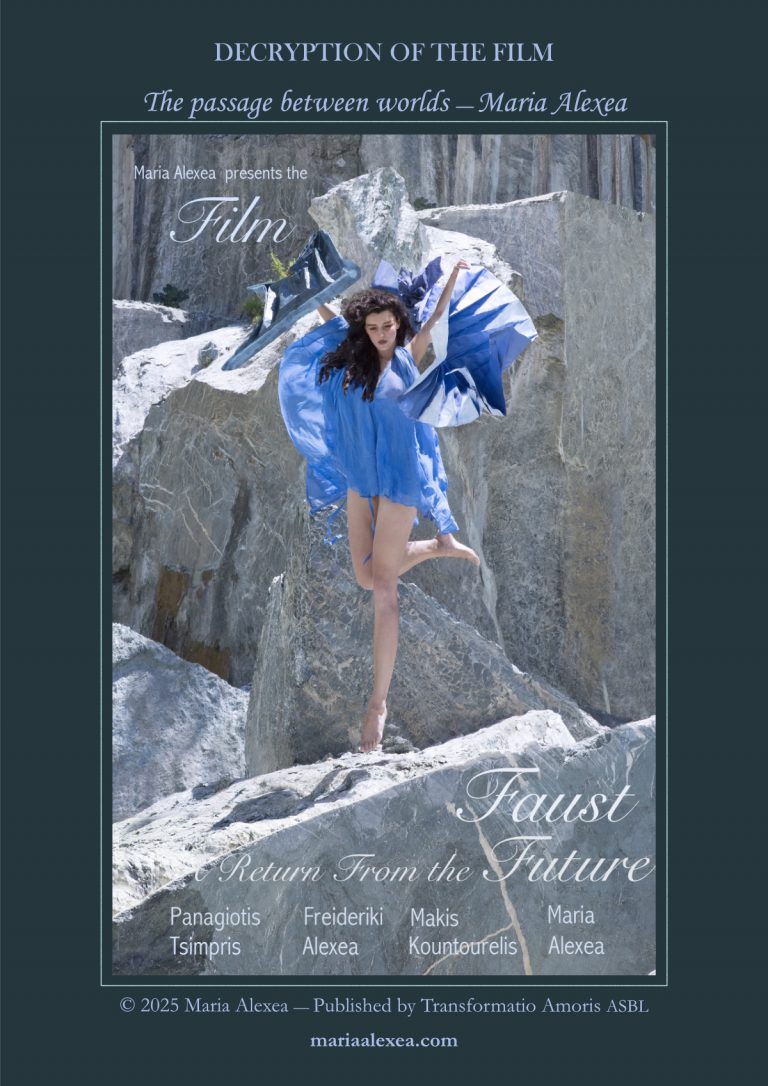
And here I return to my own work, to the film Faust — Return From the Future. For the film had already created an image that its creator had not yet learned how to read. This is one of the strangest phenomena of art: sometimes the work knows more than the one who created it.
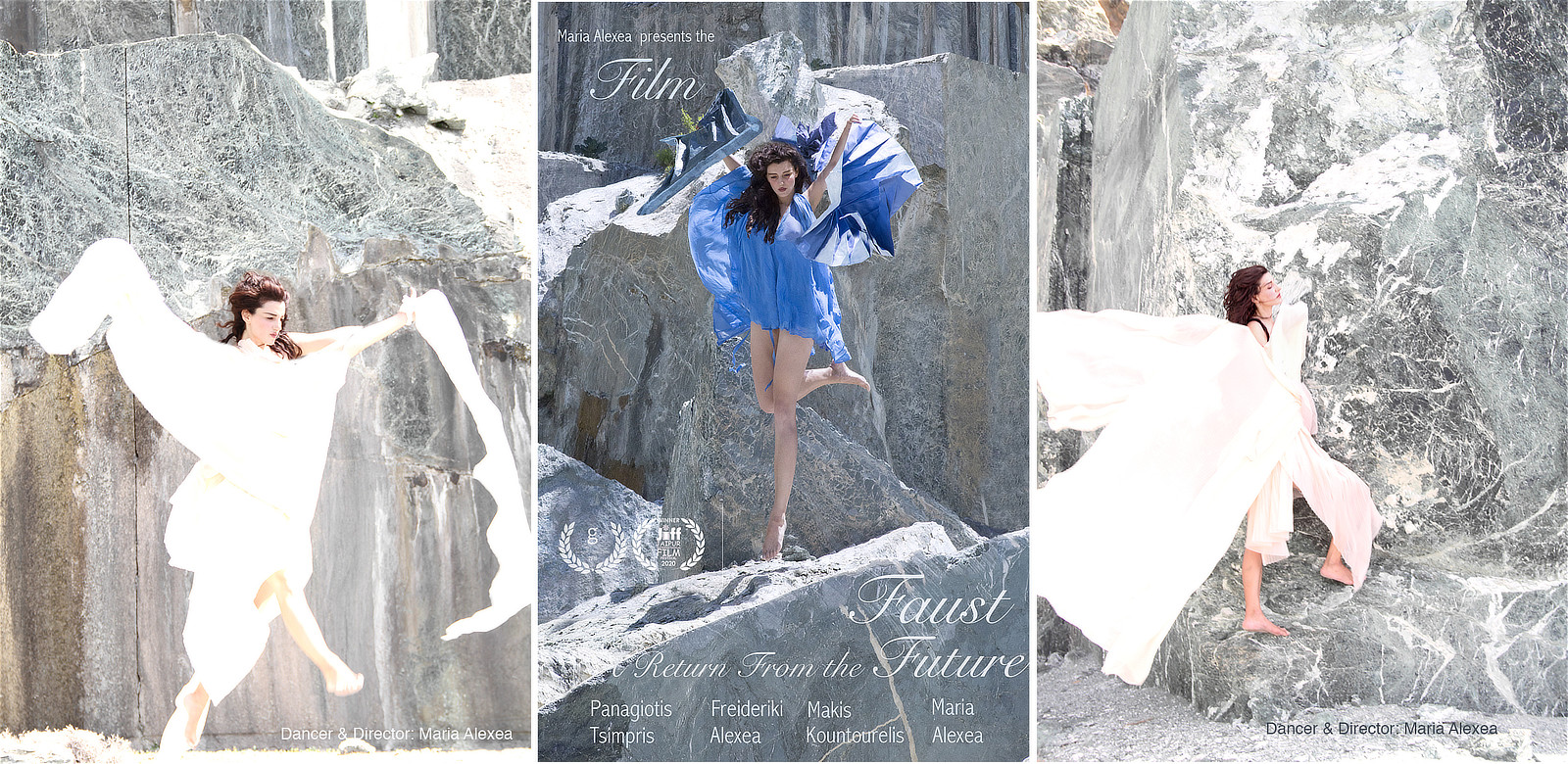
In the photographs from the film, inside the quarry, the same human body simultaneously carries both worlds. On one side is Eos: the form opens, the fabric unfolds like a wing, like an aura, like the spiralling emergence of light from enclosure. On the other is the folded geometry, the cubes within cubes, an almost origami-like form, like a field folded within another field, reality enclosed within reality.
What matters, however, is that we are not looking at two human beings. The image no longer needs the Twin as two separate forms. The same human being carries both. It carries Eos and the cube, unfolding and enclosure, the etheric and the material, the opening and the closed field. Where myth required two bodies in order to speak of lost unity, the image of the film has already returned to Unity.
This is why the title Return From the Future acquires for me today an almost literal irony. The work returned from my own future to explain to me what I had already recorded without yet possessing the theory through which to interpret it. The image preceded knowledge. The work had united what I would later have to divide into concepts in order to understand it.
The Attempt to Fragment the Work Itself
There is, finally, one further reversal that I cannot ignore. These images come from my own film, and today I am involved in judicial proceedings concerning persons and companies whom I accuse of isolating, appropriating, or reconstructing elements of my work within different advertising contexts. This has been happening in the world of advertising for years, and it is going to stop, because the era in which some people appropriate the intellectual works of others is changing. The judgment concerning specific legal responsibility belongs, of course, to the courts. On the symbolic level, however, the contrast is striking.
A work that speaks of the restoration of Unity is confronted with fragmentation. A gesture here, a mirror elsewhere, a bodily posture, a landscape, a fold, a colour, an individual form severed from the original composition and placed inside another commercial body. It is as though the very operation described throughout this chapter were being repeated upon the work itself: divide the One and make its parts appear as though they had never belonged to one another.
But here too, the system confuses the fragment with the Whole. The work is not the sum of the objects that can be removed from it. It is the inner relationship that caused them to be born as one particular universe. An individual element can be detached. The architecture that connected it to all the others cannot be detached with it.
And so the entire pattern returns to its starting point. The true self remains elsewhere. Its intermediary descends here. The realm sees the descending part, perceives that it carries something that does not belong to it, and attempts to strike it. It thinks that by striking the here, it will strike the elsewhere as well; that by cutting the Twin, it will erase the One.
It thinks.
Maria Alexea
Άρθρο (Ελ)
ΟΙ ΔΙΔΥΜΟΙ
Ο διαιρεμένος εαυτός, η κάθοδος και η μνήμη της Ενότητας
«ὅτι οὐκ ἔστιν ἡμῖν ἡ πάλη πρὸς αἷμα καὶ σάρκα, ἀλλὰ πρὸς τὰς ἀρχάς, πρὸς τὰς ἐξουσίας, πρὸς τοὺς κοσμοκράτορας τοῦ σκότους τοῦ αἰῶνος τούτου, πρὸς τὰ πνευματικὰ τῆς πονηρίας ἐν τοῖς ἐπουρανίοις.»
— Πρὸς Ἐφεσίους 6:12
Η πάλη, επομένως, δεν είναι πρωτίστως πάλη σωμάτων. Δεν διεξάγεται «πρὸς αἷμα καὶ σάρκα», αλλά ανάμεσα σε αρχές, εξουσίες και δυνάμεις που ο ίδιος ο βιβλικός λόγος τοποθετεί σε υψηλότερα πεδία. Και αν το πεδίο στο οποίο βρισκόμαστε είναι ένα πεδίο πτώσεως, τότε κάτι πρέπει να έχει προηγηθεί της πτώσεως: ένα ρήγμα, μία μετατόπιση, μία διατάραξη της αρχικής τάξεως. Η σύγκρουση που με ενδιαφέρει εδώ είναι ακριβώς αυτή: ανάμεσα σε εκείνο που διασπά και σε εκείνο που, ακόμη και μέσα στη διάσπαση, εξακολουθεί να φέρει μέσα του τη μνήμη του Ενός.
Μέσα σε αυτή τη δομή αποκτούν διαφορετικό νόημα οι Δίδυμοι. Δεν είναι απλώς δύο όμοια ανθρώπινα όντα ούτε απλώς δύο μισά που έχασαν το ένα το άλλο. Είναι η εικόνα ενός ενιαίου εαυτού που έχει κατανεμηθεί ανάμεσα σε δύο πεδία υπάρξεως. Ο ένας εαυτός, ίσως ο πληρέστερος, ο αληθινά αθάνατος φυσικός εαυτός, παραμένει αλλού — σε ένα πεδίο το οποίο ο εδώ άνθρωπος δεν μπορεί πλέον να αντιληφθεί. Από αυτόν, όμως, μία μεσότητα, ένα πνευματικό ή αιθερικό αντίστοιχο, έχει κατέλθει στη γη και έχει εισέλθει μέσα στην πυκνότητα αυτού του κόσμου. Και έχει χάσει τη μνήμη του αδελφού εαυτού που βρίσκεται έξω.
Και εδώ διατυπώνω μία υπόθεση — για την οποία φέρω και την ευθύνη, γιατί δεν υπάρχει παρόμοια — που αλλάζει ολόκληρη την έννοια της πτώσεως: ίσως αυτή η κάθοδος να μην ήταν ατύχημα αλλά αποστολή. Ίσως ο κατελθών εαυτός να ήρθε αυτοβούλως στο πεδίο αυτό, όχι επειδή αποκόπηκε απλώς από την πηγή του, αλλά επειδή έπρεπε να μεταφέρει κάτι μέσα του. Μία μνήμη του φωτός. Μία δίοδο. Μία δυνατότητα εξόδου. Ίσως κατήλθε ακριβώς για να βοηθήσει εκείνους που έχουν ξεχάσει ότι υπάρχει κάτι έξω από το πεδίο στο οποίο γεννήθηκαν.
Ο «Δίδυμος» είναι τότε η ορατή ανάμνηση αυτής της διπλής καταστάσεως. Ο ένας εαυτός βρίσκεται εδώ, εντός της σκοτεινής, πεσμένης γης του τραύματος και της λήθης· ο άλλος ίσως εξακολουθεί να υπάρχει και να μάχεται αλλού. Δεν είναι δύο διαφορετικές προσωπικότητες. Είναι δύο εκδηλώσεις μιας βαθύτερης ενότητας, χωρισμένες όχι απλώς στον χώρο αλλά σε διαφορετικές βαθμίδες πραγματικότητας. Ο πραγματικός χωρισμός δεν βρίσκεται επομένως ανάμεσα σε δύο ανθρώπους. Βρίσκεται μέσα στον ίδιο τον άνθρωπο.
Ίσως ακριβώς αυτό να διατηρεί, σε μυθολογική μορφή, το ζεύγος Κάστορα και Πολυδεύκη. Ο Κάστωρ είναι θνητός, ενώ ο Πολυδεύκης αθάνατος. Στη δική μου ανάγνωση, ο Πολυδεύκης αντιστοιχεί στον φυσικό, αθάνατο εαυτό, ενώ ο Κάστωρ στη μεσότητά του που έχει ξεμείνει εδώ. Είναι δύο, αλλά στην πραγματικότητα ένα. Και όταν η διαίρεση φτάνει στο άκρο της, ο μύθος καταλήγει σε μία παράξενη, σχεδόν σαδιστική συμβιβαστική λύση: η ύπαρξή τους μοιράζεται ανάμεσα στα δύο πεδία. Η διαίρεση δεν εξαφανίζεται, αλλά ούτε αφήνεται να γίνει απόλυτη.
Οι Δίδυμοι Πύργοι και το πλήγμα στο διπλό
Εδώ αποκτά για μένα ιδιαίτερη συμβολική σημασία η εικόνα των Διδύμων Πύργων. Με ενδιαφέρει η εικόνα ως σύμβολο: δύο σχεδόν όμοιοι κατακόρυφοι άξονες, δύο σώματα που φέρουν ένα και το αυτό όνομα — οι Δίδυμοι.
Το κατασκευασμένο ψέμα είχε φροντίσει ώστε ο ένας από τους δύο πύργους να είναι διαφανής. Το αεροπλάνο περνά μέσα του. Δεν πρόκειται πια για δύο εξίσου συμπαγή κτίσματα, αλλά για δύο διαφορετικές καταστάσεις του ίδιου άξονα: το φυσικό και το λεπτότερο, το υλικό και το αιθερικό, το σώμα και τη μεσότητα που κατέβηκε μαζί του. Και τότε το πλήγμα αποκτά διαφορετικό συμβολισμό. Χτυπώντας τον διαφανή πύργο, το σκοτεινό πεδίο νομίζει ότι μπορεί να πλήξει μέσω αυτού και το άλλο μέρος, εκείνο που παραμένει στο διαφορετικό επίπεδο.
Η λέξη νομίζει είναι καίρια. Γιατί εδώ βρίσκεται η ύβρις του σκοτεινού συστήματος. Συγχέει το περίβλημα με την πηγή, τον φορέα με εκείνο που ο φορέας μεταφέρει. Πιστεύει ότι αν καταστρέψει το σώμα που φέρει το φως, έχει καταστρέψει και το ίδιο το φως. Όμως το σκοτάδι δεν μπορεί να νικήσει το φως με τον ίδιο τρόπο που ένα σώμα νικά ένα άλλο σώμα. Η ίδια η έννοια του σκότους προϋποθέτει την απουσία φωτός· δεν είναι ένα δεύτερο φως ικανό να το ακυρώσει.
Γι’ αυτό το πλήγμα μπορεί να συντρίψει το κατελθόν μέρος. Μπορεί να χαράξει επάνω του το στίγμα της βίας. Αλλά ακριβώς αυτό το στίγμα μπορεί αργότερα να μετατραπεί στο σημείο μέσω του οποίου τα δύο μέρη θα αναγνωριστούν και πάλι.
Γιατί οι πραγματικοί δίδυμοι;
Μέσα σε αυτή την ανάγνωση αποκτά τρομακτική σημασία και η ιστορική εμμονή με τα πειράματα σε πραγματικούς διδύμους. Η επιστήμη έχει πράγματι χρησιμοποιήσει μελέτες διδύμων για να ερευνήσει τη σχέση γενετικής και περιβάλλοντος· όμως στην εγκληματική της εκτροπή αυτή η δυνατότητα έφθασε στο απόλυτο σκοτάδι με τα πειράματα του Josef Mengele. Οι δίδυμοι ήταν γι’ αυτόν ιδιαίτερα χρήσιμοι επειδή επέτρεπαν να επέμβει κανείς στον έναν και να συγκρίνει το αποτέλεσμα με τον άλλο.
Αυτό που με ενδιαφέρει είναι η τρομακτική συμβολική αντιστοιχία. Το σκοτεινό σύστημα παίρνει ένα πραγματικό ζεύγος διδύμων και επιχειρεί πάνω του ακριβώς την πράξη της διαίρεσης: χωρίζει, επεμβαίνει, μεταβάλλει τον έναν, παρατηρεί τον άλλο. Εκεί όπου ο αρχέτυπος Δίδυμος δηλώνει μία κρυμμένη ενότητα πίσω από δύο μορφές, η βίαιη εξουσία προσπαθεί να μετατρέψει τις δύο μορφές σε απολύτως χωριστά πειραματικά αντικείμενα.
Στη συμβολική ερμηνεία που προτείνω, λοιπόν, η επίθεση στον πραγματικό δίδυμο μπορεί να διαβαστεί ως εικόνα μιας βαθύτερης απόπειρας: να πληγεί το ίδιο το φαινόμενο του διπλού εαυτού. Να διακοπεί η γέφυρα ανάμεσα στο μέρος που κατήλθε εδώ και στον εαυτό από τον οποίο προήλθε. Να αποδειχθεί, με τη βία, ότι το ένα μπορεί να αλλοιωθεί χωρίς το άλλο, ότι το ένα είναι πραγματικά ξένο προς το άλλο, ότι η ενότητα ήταν ψευδαίσθηση.
Αλλά το ερώτημα παραμένει: πόσο βαθιά μπορεί πράγματι να φτάσει η διαίρεση;
Η κβαντική ρωγμή στην έννοια του χωρισμού
Εδώ η κβαντική φυσική εισέρχεται στο κείμενο όχι ως μεταφυσική απόδειξη, αλλά ως μία εκπληκτική ρωγμή στην απλοϊκή έννοια της ανεξαρτησίας. Στην κβαντική διεμπλοκή δύο σωματίδια μπορούν να περιγράφονται από μία κοινή κβαντική κατάσταση και να παρουσιάζουν συσχετίσεις που δεν μπορούν να αναπαρασταθούν ως δύο πλήρως ανεξάρτητες κλασικές ιστορίες. Η απόσταση ανάμεσά τους δεν εξαφανίζεται, ούτε αυτό σημαίνει ότι ανταλλάσσουν μυστικά μηνύματα ταχύτερα από το φως. Σημαίνει, όμως, ότι η χωρική διάκριση δεν εξαντλεί κατ’ ανάγκην το τι είναι ένα σύστημα.
Αυτό είναι το πραγματικά ριζοσπαστικό νόημα της διεμπλοκής. Όχι ότι δύο σωματίδια «μιλούν» μυστικά από απόσταση ούτε ότι το ένα στέλνει μήνυμα στο άλλο ταχύτερα από το φως. Αλλά ότι η πραγματικότητα, στο κβαντικό επίπεδο, δεν επιτρέπει πάντοτε να θεωρήσουμε πρώτα τα δύο μέρη ως απολύτως ανεξάρτητα αντικείμενα και ύστερα να προσθέσουμε τη σχέση τους. Μερικές φορές η σχέση είναι πρωταρχική: το σύστημα προηγείται, κατά μία έννοια, των ανεξάρτητων περιγραφών των μερών του.
Εδώ βρίσκεται η πραγματική δύναμη της κβαντικής φυσικής για τη δική μου σκέψη. Δεν αποδεικνύει τον Δίδυμο που προτείνω. Αλλά καταστρέφει την παλαιά βεβαιότητα ότι «χωριστό» σημαίνει αναγκαστικά και «ανεξάρτητο». Δύο πράγματα μπορούν να απέχουν τεράστια απόσταση και παρ’ όλα αυτά η πληρέστερη φυσική περιγραφή τους να εξακολουθεί να ανήκει σε μία κοινή κατάσταση. Ο χωρισμός στον χώρο δεν αρκεί πάντοτε για να διαλύσει το Όλον.
Θωμᾶς ὁ λεγόμενος Δίδυμος
Και τότε η σκηνή του Θωμά και του Ιησού αλλάζει εντελώς. Το Ευαγγέλιο επιμένει να μας πληροφορήσει ότι ο Θωμάς είναι «ὁ λεγόμενος Δίδυμος». Όταν ο Ιησούς επιστρέφει, ο Θωμάς δεν ζητεί απλώς να τον δει. Ζητεί να δει «τὸν τύπον τῶν ἥλων». Τον τύπο: το αποτύπωμα, το ίχνος που άφησε επάνω στο σώμα η διαδρομή του μέσα από την ύλη και τον θάνατο.
Μέσα στη δική μου ανάγνωση, ο τύπος των ήλων γίνεται η υπογραφή του κατελθόντος εαυτού. Ο Δίδυμος ζητεί από εκείνον που επέστρεψε: δείξε μου το σημάδι σου, για να γνωρίσω ότι είσαι πράγματι εσύ. Και βαθύτερα: δείξε μου την υπογραφή σου, για να καταλάβω ότι είσαι εγώ. Η πληγή δεν είναι πλέον απλώς απόδειξη του Πάθους· γίνεται σημείο αναγνωρίσεως ανάμεσα στα δύο επίπεδα του ίδιου όντος.
Εδώ βρίσκεται η μεγαλειώδης αντιστροφή. Το σύστημα χάραξε το τραύμα για να εξαφανίσει εκείνον που κατέβηκε. Αλλά μετά την επιστροφή το ίδιο τραύμα είναι εκείνο που τον αναγνωρίζει. Το στίγμα της βίας μετατρέπεται σε σφραγίδα ταυτότητας. Το όπλο που προοριζόταν να ολοκληρώσει τη διάσπαση παράγει τελικά την απόδειξη της συνέχειας.
Αυτή είναι η συμβολική εκδίκηση της ίδιας της δομής.
Το σκοτάδι γράφει την υπογραφή του επάνω στον φορέα του φωτός — και, χωρίς να το καταλαβαίνει, γράφει συγχρόνως την υπογραφή με την οποία ο φορέας του φωτός θα αναγνωριστεί όταν επιστρέψει.
Ἠώς — Ἔρως — Ἥρως
Εδώ συναντώνται για μένα τρεις λέξεις, όχι ετυμολογικά αλλά ποιητικά: Ἠώς, Ἔρως, Ἥρως. Η Ἠώς ανοίγει το σκοτάδι και γεννά το φως. Ο ἔρως ωθεί το χωρισμένο προς εκείνο από το οποίο αποσπάστηκε. Ο ἥρως είναι εκείνος που κατέρχεται μέσα στο επικίνδυνο πεδίο, φέρει το τραύμα της καθόδου και επιστρέφει.
Ο ήρωας, μέσα σε αυτή τη δομή, δεν είναι απλώς εκείνος που υποφέρει. Είναι εκείνος που φέρει κάτι μέσα στο πεδίο. Κάτι που δεν προέρχεται από αυτό, αλλά εισέρχεται σε αυτό. Και ακριβώς επειδή το φέρει, γίνεται στόχος του.
Faust — Return From the Future: η επιστροφή στη Μονάδα
Όμως ο τελικός συμβολισμός δεν βρίσκεται στους Διδύμους. Βρίσκεται στην υπέρβασή τους.
Και εδώ επιστρέφω στο ίδιο μου το έργο, στην ταινία Faust — Return From the Future. Γιατί η ταινία είχε ήδη δημιουργήσει μία εικόνα την οποία ο δημιουργός της δεν είχε ακόμη μάθει να διαβάζει. Αυτό είναι ένα από τα πιο παράξενα φαινόμενα της τέχνης: κάποτε το έργο γνωρίζει περισσότερα από εκείνον που το δημιούργησε.
Στις φωτογραφίες της ταινίας, μέσα στο λατομείο, το ίδιο ανθρώπινο σώμα φέρει συγχρόνως τους δύο κόσμους. Από τη μία πλευρά βρίσκεται η Ἠώς: η μορφή ανοίγει, το ύφασμα εκπτύσσεται σαν πτέρυγα, σαν αύρα, σαν σπειροειδής έξοδος του φωτός από το κλειστό. Από την άλλη βρίσκεται η πτυχωμένη γεωμετρία, οι κύβοι μέσα στους κύβους, μία μορφή σχεδόν origami, σαν πεδίο διπλωμένο μέσα σε άλλο πεδίο, πραγματικότητα εγκιβωτισμένη μέσα σε πραγματικότητα.
Το ουσιώδες, όμως, είναι ότι δεν βλέπουμε δύο ανθρώπους. Η εικόνα δεν χρειάζεται πλέον τον Δίδυμο ως δύο χωριστές μορφές. Ο ίδιος άνθρωπος φέρει και τα δύο. Φέρει την Ἠώ και τον κύβο, την εκδίπλωση και την περίκλειση, το αιθερικό και το υλικό, το άνοιγμα και το κλειστό πεδίο. Εκεί όπου ο μύθος χρειαζόταν δύο σώματα για να μιλήσει για τη χαμένη ενότητα, η εικόνα της ταινίας έχει ήδη επιστρέψει στη Μονάδα.
Γι’ αυτό ο τίτλος Return From the Future αποκτά για μένα σήμερα μία σχεδόν κυριολεκτική ειρωνεία. Το έργο επέστρεψε από το δικό μου μέλλον για να μου εξηγήσει τι είχα ήδη καταγράψει χωρίς ακόμη να διαθέτω τη θεωρία που θα το ερμήνευε. Η εικόνα προηγήθηκε της γνώσης. Το έργο είχε ενώσει αυτό που εγώ χρειάστηκε αργότερα να χωρίσω σε έννοιες για να μπορέσω να το κατανοήσω.
Η απόπειρα διασπάσεως του ίδιου του έργου
Υπάρχει, τέλος, μία ακόμη αντιστροφή που δεν μπορώ να αγνοήσω. Οι εικόνες αυτές προέρχονται από τη δική μου ταινία και σήμερα βρίσκομαι σε δικαστικές διαδικασίες σε σχέση με πρόσωπα και εταιρείες τα οποία κατηγορώ ότι απομόνωσαν, οικειοποιήθηκαν ή ανασύνθεσαν στοιχεία του έργου μου μέσα σε διαφορετικά διαφημιστικά συμφραζόμενα. Αυτό γίνεται από τον κόσμο της διαφήμισης εδώ και χρόνια και πρόκειται να σταματήσει, γιατί αλλάζει η εποχή κατά την οποία κάποιοι ιδιοποιούνται πνευματικά έργα άλλων. Η κρίση για τις συγκεκριμένες νομικές ευθύνες ανήκει βεβαίως στα δικαστήρια. Στο συμβολικό επίπεδο, όμως, η αντίθεση είναι εντυπωσιακή.
Ένα έργο που μιλά για την επαναφορά της Μονάδας αντιμετωπίζεται με θραυσματοποίηση. Μία χειρονομία εδώ, ένας καθρέπτης αλλού, μία στάση σώματος, ένα τοπίο, μία πτύχωση, ένα χρώμα, ένα επιμέρους σχήμα αποκομμένο από την αρχική σύνθεση και τοποθετημένο σε άλλο εμπορικό σώμα. Είναι σαν να επαναλαμβάνεται επάνω στο ίδιο το έργο εκείνο που περιγράφει ολόκληρο αυτό το κεφάλαιο: διαίρεσε το Ένα και κάνε τα μέρη του να εμφανίζονται σαν να μην είχαν ποτέ σχέση μεταξύ τους.
Αλλά και εδώ το σύστημα συγχέει το θραύσμα με το Όλον. Το έργο δεν είναι το άθροισμα των αντικειμένων που μπορεί κανείς να αφαιρέσει από αυτό. Είναι η εσωτερική σχέση που τα έκανε να γεννηθούν ως ένα συγκεκριμένο σύμπαν. Ένα επιμέρους στοιχείο μπορεί να αποσπαστεί. Η αρχιτεκτονική που το συνέδεε με όλα τα υπόλοιπα δεν αποσπάται μαζί του.
Και έτσι ολόκληρο το μοτίβο επιστρέφει στο αρχικό του σημείο. Ο αληθινός εαυτός παραμένει αλλού. Η μεσότητά του κατέρχεται εδώ. Το πεδίο βλέπει το κατελθόν μέρος, αντιλαμβάνεται ότι φέρει κάτι που δεν του ανήκει και επιχειρεί να το πλήξει. Νομίζει ότι χτυπώντας το εδώ θα χτυπήσει και το αλλού· ότι κόβοντας τον Δίδυμο θα εξαφανίσει το Ένα.
Νομίζει.
Μαρία Αλεξέα
📖 English Edition
«The Firebird, the Idolious Hermes and the Passage of Eos»
📖 Greek Edition
«Τὸ Πουλὶ τῆς Φωτιᾶς, ὁ i-δόλιος Ἑρμῆς καὶ τὸ Πέρασμα τῆς Ἠοῦς»
Article (En)
THE TWINS
The Divided Self, the Descent, and the Memory of Unity
“For our struggle is not against flesh and blood, but against the principalities, against the powers, against the rulers of the darkness of this age, against the spiritual forces of wickedness in the heavenly realms.”
— Ephesians 6:12
The struggle, therefore, is not primarily a struggle between bodies. It is not waged “against flesh and blood,” but among principles, powers, and forces which the biblical text itself places in higher realms. And if the realm in which we find ourselves is a fallen realm, then something must have preceded that fall: a rupture, a displacement, a disturbance of the original order. The conflict that concerns me here is precisely this one: between that which divides and that which, even within division, continues to carry within itself the memory of the One.
Within this structure, the Twins acquire a different meaning. They are not simply two similar human beings, nor merely two halves that have lost one another. They are the image of a single self distributed between two realms of existence. One self, perhaps the fuller one, the truly immortal natural self, remains elsewhere — in a realm that the human being here can no longer perceive. From that self, however, an intermediary, a spiritual or etheric counterpart, has descended to Earth and entered into the density of this world. And it has lost the memory of the brother-self that remains outside.
And here I propose a hypothesis — for which I take responsibility, because I know of no equivalent one — that changes the entire meaning of the Fall: perhaps this descent was not an accident, but a mission. Perhaps the descending self came voluntarily into this realm, not simply because it had been severed from its source, but because it had to carry something into it. A memory of light. A passage. A possibility of escape. Perhaps it descended precisely in order to help those who have forgotten that something exists beyond the realm into which they were born.
The “Twin” is then the visible memory of this double condition. One self is here, within the dark, fallen Earth of trauma and oblivion; the other may still exist and struggle elsewhere. They are not two different personalities. They are two manifestations of a deeper unity, separated not merely in space but across different levels of reality. The true division, therefore, does not lie between two human beings. It lies within the human being himself.
Perhaps this is precisely what the pair Castor and Polydeuces preserves in mythological form. Castor is mortal, whereas Polydeuces is immortal. In my reading, Polydeuces corresponds to the natural, immortal self, while Castor corresponds to its intermediary that has been left behind here. They are two, but in reality one. And when the division reaches its extreme, the myth arrives at a strange, almost sadistic compromise: their existence is divided between the two realms. The division does not disappear, but neither is it allowed to become absolute.
The Twin Towers and the Strike Against the Double
Here the image of the Twin Towers acquires, for me, a particular symbolic significance. What interests me is the image as symbol: two almost identical vertical axes, two bodies bearing one and the same name — the Twins.
The constructed lie had ensured that one of the two towers was transparent. The airplane passes through it. We are no longer dealing with two equally solid structures, but with two different states of the same axis: the physical and the subtler, the material and the etheric, the body and the intermediary that descended with it. The strike then acquires a different symbolism. By striking the transparent tower, the dark realm thinks that through it, it can also strike the other part, the one that remains on the different plane.
The word thinks is crucial. For here lies the hubris of the dark system. It confuses the envelope with the source, the bearer with that which the bearer carries. It believes that if it destroys the body that carries the light, it has destroyed the light itself. Yet darkness cannot defeat light in the same way that one body defeats another body. The very concept of darkness presupposes the absence of light; it is not a second light capable of cancelling the first.
The strike can therefore shatter the part that descended. It can carve upon it the mark of violence. But precisely that mark may later become the point through which the two parts recognize one another again.
Why Real Twins?
Within this reading, the historical obsession with experiments on real twins acquires a terrifying significance. Science has indeed used twin studies to investigate the relationship between genetics and environment; but in its criminal perversion, this possibility reached absolute darkness in the experiments of Josef Mengele. Twins were particularly useful to him because they made it possible to intervene upon one and compare the result with the other.
What interests me is the terrifying symbolic correspondence. The dark system takes a real pair of twins and performs upon them precisely the act of division: it separates, intervenes, alters one, observes the other. Where the archetypal Twin signifies a hidden unity behind two forms, violent power attempts to transform those two forms into completely separate experimental objects.
In the symbolic interpretation I propose, therefore, the attack upon the real twin can be read as the image of a deeper attempt: to wound the very phenomenon of the double self. To sever the bridge between the part that descended here and the self from which it originated. To prove, through violence, that one can be altered without the other, that one is truly foreign to the other, that unity was an illusion.
But the question remains: how deep can division truly reach?
The Quantum Rupture in the Concept of Separation
Here quantum physics enters the text not as metaphysical proof, but as an extraordinary rupture in the simplistic notion of independence. In quantum entanglement, two particles can be described by a shared quantum state and can display correlations that cannot be represented as two completely independent classical histories. The distance between them does not disappear, nor does this mean that they exchange secret messages faster than light. It means, however, that spatial separation does not necessarily exhaust what a system is.
This is the truly radical meaning of entanglement. Not that two particles secretly “speak” to one another across a distance, nor that one sends a message to the other faster than light. Rather, reality at the quantum level does not always allow us first to regard the two parts as absolutely independent objects and only afterwards add their relationship. Sometimes the relationship is primary: the system precedes, in a certain sense, the independent descriptions of its parts.
Here lies the real power of quantum physics for my own thought. It does not prove the Twin I propose. But it destroys the old certainty that “separate” necessarily means “independent.” Two things can be separated by an immense distance and yet their fullest physical description may still belong to a common state. Separation in space is not always enough to dissolve the Whole.
Thomas, Who Is Called Didymus — the Twin
And then the scene between Thomas and Jesus changes completely. The Gospel insists on informing us that Thomas is “the one called Didymus” — the Twin. When Jesus returns, Thomas does not simply ask to see him. He asks to see “the imprint of the nails.” The imprint: the trace, the mark left upon the body by its passage through matter and death.
In my reading, the imprint of the nails becomes the signature of the descending self. The Twin asks the one who has returned: show me your mark, so that I may know that you are truly you. And, at a deeper level: show me your signature, so that I may understand that you are me. The wound is no longer merely evidence of the Passion; it becomes the point of recognition between the two levels of the same being.
Here lies the magnificent reversal. The system carved the wound in order to erase the one who had descended. But after the return, that same wound is what allows him to be recognized. The stigma of violence becomes a seal of identity. The weapon intended to complete the division ultimately produces the proof of continuity.
This is the symbolic revenge of the structure itself.
Darkness writes its signature upon the bearer of light — and, without realizing it, simultaneously writes the signature by which the bearer of light will be recognized when he returns.
Eos — Eros — Hero
Here, for me, three words meet — not etymologically, but poetically: Eos, Eros, Hero. Eos opens the darkness and gives birth to light. Eros drives what has been separated toward that from which it was torn away. And the Hero is the one who descends into the dangerous realm, bears the wound of the descent, and returns.
Within this structure, the hero is not simply the one who suffers. He is the one who carries something into the realm. Something that does not originate from it, but enters it. And precisely because he carries it, he becomes its target.
Faust — Return From the Future: The Return to Unity
Yet the final symbolism does not lie in the Twins. It lies in their transcendence.
And here I return to my own work, to the film Faust — Return From the Future. For the film had already created an image that its creator had not yet learned how to read. This is one of the strangest phenomena of art: sometimes the work knows more than the one who created it.
In the photographs from the film, inside the quarry, the same human body simultaneously carries both worlds. On one side is Eos: the form opens, the fabric unfolds like a wing, like an aura, like the spiralling emergence of light from enclosure. On the other is the folded geometry, the cubes within cubes, an almost origami-like form, like a field folded within another field, reality enclosed within reality.
What matters, however, is that we are not looking at two human beings. The image no longer needs the Twin as two separate forms. The same human being carries both. It carries Eos and the cube, unfolding and enclosure, the etheric and the material, the opening and the closed field. Where myth required two bodies in order to speak of lost unity, the image of the film has already returned to Unity.
This is why the title Return From the Future acquires for me today an almost literal irony. The work returned from my own future to explain to me what I had already recorded without yet possessing the theory through which to interpret it. The image preceded knowledge. The work had united what I would later have to divide into concepts in order to understand it.
The Attempt to Fragment the Work Itself
There is, finally, one further reversal that I cannot ignore. These images come from my own film, and today I am involved in judicial proceedings concerning persons and companies whom I accuse of isolating, appropriating, or reconstructing elements of my work within different advertising contexts. This has been happening in the world of advertising for years, and it is going to stop, because the era in which some people appropriate the intellectual works of others is changing. The judgment concerning specific legal responsibility belongs, of course, to the courts. On the symbolic level, however, the contrast is striking.
A work that speaks of the restoration of Unity is confronted with fragmentation. A gesture here, a mirror elsewhere, a bodily posture, a landscape, a fold, a colour, an individual form severed from the original composition and placed inside another commercial body. It is as though the very operation described throughout this chapter were being repeated upon the work itself: divide the One and make its parts appear as though they had never belonged to one another.
But here too, the system confuses the fragment with the Whole. The work is not the sum of the objects that can be removed from it. It is the inner relationship that caused them to be born as one particular universe. An individual element can be detached. The architecture that connected it to all the others cannot be detached with it.
And so the entire pattern returns to its starting point. The true self remains elsewhere. Its intermediary descends here. The realm sees the descending part, perceives that it carries something that does not belong to it, and attempts to strike it. It thinks that by striking the here, it will strike the elsewhere as well; that by cutting the Twin, it will erase the One.
It thinks.
Maria Alexea
Άρθρο (Ελ)
ΟΙ ΔΙΔΥΜΟΙ
Ο διαιρεμένος εαυτός, η κάθοδος και η μνήμη της Ενότητας
«ὅτι οὐκ ἔστιν ἡμῖν ἡ πάλη πρὸς αἷμα καὶ σάρκα, ἀλλὰ πρὸς τὰς ἀρχάς, πρὸς τὰς ἐξουσίας, πρὸς τοὺς κοσμοκράτορας τοῦ σκότους τοῦ αἰῶνος τούτου, πρὸς τὰ πνευματικὰ τῆς πονηρίας ἐν τοῖς ἐπουρανίοις.»
— Πρὸς Ἐφεσίους 6:12
Η πάλη, επομένως, δεν είναι πρωτίστως πάλη σωμάτων. Δεν διεξάγεται «πρὸς αἷμα καὶ σάρκα», αλλά ανάμεσα σε αρχές, εξουσίες και δυνάμεις που ο ίδιος ο βιβλικός λόγος τοποθετεί σε υψηλότερα πεδία. Και αν το πεδίο στο οποίο βρισκόμαστε είναι ένα πεδίο πτώσεως, τότε κάτι πρέπει να έχει προηγηθεί της πτώσεως: ένα ρήγμα, μία μετατόπιση, μία διατάραξη της αρχικής τάξεως. Η σύγκρουση που με ενδιαφέρει εδώ είναι ακριβώς αυτή: ανάμεσα σε εκείνο που διασπά και σε εκείνο που, ακόμη και μέσα στη διάσπαση, εξακολουθεί να φέρει μέσα του τη μνήμη του Ενός.
Μέσα σε αυτή τη δομή αποκτούν διαφορετικό νόημα οι Δίδυμοι. Δεν είναι απλώς δύο όμοια ανθρώπινα όντα ούτε απλώς δύο μισά που έχασαν το ένα το άλλο. Είναι η εικόνα ενός ενιαίου εαυτού που έχει κατανεμηθεί ανάμεσα σε δύο πεδία υπάρξεως. Ο ένας εαυτός, ίσως ο πληρέστερος, ο αληθινά αθάνατος φυσικός εαυτός, παραμένει αλλού — σε ένα πεδίο το οποίο ο εδώ άνθρωπος δεν μπορεί πλέον να αντιληφθεί. Από αυτόν, όμως, μία μεσότητα, ένα πνευματικό ή αιθερικό αντίστοιχο, έχει κατέλθει στη γη και έχει εισέλθει μέσα στην πυκνότητα αυτού του κόσμου. Και έχει χάσει τη μνήμη του αδελφού εαυτού που βρίσκεται έξω.
Και εδώ διατυπώνω μία υπόθεση — για την οποία φέρω και την ευθύνη, γιατί δεν υπάρχει παρόμοια — που αλλάζει ολόκληρη την έννοια της πτώσεως: ίσως αυτή η κάθοδος να μην ήταν ατύχημα αλλά αποστολή. Ίσως ο κατελθών εαυτός να ήρθε αυτοβούλως στο πεδίο αυτό, όχι επειδή αποκόπηκε απλώς από την πηγή του, αλλά επειδή έπρεπε να μεταφέρει κάτι μέσα του. Μία μνήμη του φωτός. Μία δίοδο. Μία δυνατότητα εξόδου. Ίσως κατήλθε ακριβώς για να βοηθήσει εκείνους που έχουν ξεχάσει ότι υπάρχει κάτι έξω από το πεδίο στο οποίο γεννήθηκαν.
Ο «Δίδυμος» είναι τότε η ορατή ανάμνηση αυτής της διπλής καταστάσεως. Ο ένας εαυτός βρίσκεται εδώ, εντός της σκοτεινής, πεσμένης γης του τραύματος και της λήθης· ο άλλος ίσως εξακολουθεί να υπάρχει και να μάχεται αλλού. Δεν είναι δύο διαφορετικές προσωπικότητες. Είναι δύο εκδηλώσεις μιας βαθύτερης ενότητας, χωρισμένες όχι απλώς στον χώρο αλλά σε διαφορετικές βαθμίδες πραγματικότητας. Ο πραγματικός χωρισμός δεν βρίσκεται επομένως ανάμεσα σε δύο ανθρώπους. Βρίσκεται μέσα στον ίδιο τον άνθρωπο.
Ίσως ακριβώς αυτό να διατηρεί, σε μυθολογική μορφή, το ζεύγος Κάστορα και Πολυδεύκη. Ο Κάστωρ είναι θνητός, ενώ ο Πολυδεύκης αθάνατος. Στη δική μου ανάγνωση, ο Πολυδεύκης αντιστοιχεί στον φυσικό, αθάνατο εαυτό, ενώ ο Κάστωρ στη μεσότητά του που έχει ξεμείνει εδώ. Είναι δύο, αλλά στην πραγματικότητα ένα. Και όταν η διαίρεση φτάνει στο άκρο της, ο μύθος καταλήγει σε μία παράξενη, σχεδόν σαδιστική συμβιβαστική λύση: η ύπαρξή τους μοιράζεται ανάμεσα στα δύο πεδία. Η διαίρεση δεν εξαφανίζεται, αλλά ούτε αφήνεται να γίνει απόλυτη.
Οι Δίδυμοι Πύργοι και το πλήγμα στο διπλό
Εδώ αποκτά για μένα ιδιαίτερη συμβολική σημασία η εικόνα των Διδύμων Πύργων. Με ενδιαφέρει η εικόνα ως σύμβολο: δύο σχεδόν όμοιοι κατακόρυφοι άξονες, δύο σώματα που φέρουν ένα και το αυτό όνομα — οι Δίδυμοι.
Το κατασκευασμένο ψέμα είχε φροντίσει ώστε ο ένας από τους δύο πύργους να είναι διαφανής. Το αεροπλάνο περνά μέσα του. Δεν πρόκειται πια για δύο εξίσου συμπαγή κτίσματα, αλλά για δύο διαφορετικές καταστάσεις του ίδιου άξονα: το φυσικό και το λεπτότερο, το υλικό και το αιθερικό, το σώμα και τη μεσότητα που κατέβηκε μαζί του. Και τότε το πλήγμα αποκτά διαφορετικό συμβολισμό. Χτυπώντας τον διαφανή πύργο, το σκοτεινό πεδίο νομίζει ότι μπορεί να πλήξει μέσω αυτού και το άλλο μέρος, εκείνο που παραμένει στο διαφορετικό επίπεδο.
Η λέξη νομίζει είναι καίρια. Γιατί εδώ βρίσκεται η ύβρις του σκοτεινού συστήματος. Συγχέει το περίβλημα με την πηγή, τον φορέα με εκείνο που ο φορέας μεταφέρει. Πιστεύει ότι αν καταστρέψει το σώμα που φέρει το φως, έχει καταστρέψει και το ίδιο το φως. Όμως το σκοτάδι δεν μπορεί να νικήσει το φως με τον ίδιο τρόπο που ένα σώμα νικά ένα άλλο σώμα. Η ίδια η έννοια του σκότους προϋποθέτει την απουσία φωτός· δεν είναι ένα δεύτερο φως ικανό να το ακυρώσει.
Γι’ αυτό το πλήγμα μπορεί να συντρίψει το κατελθόν μέρος. Μπορεί να χαράξει επάνω του το στίγμα της βίας. Αλλά ακριβώς αυτό το στίγμα μπορεί αργότερα να μετατραπεί στο σημείο μέσω του οποίου τα δύο μέρη θα αναγνωριστούν και πάλι.
Γιατί οι πραγματικοί δίδυμοι;
Μέσα σε αυτή την ανάγνωση αποκτά τρομακτική σημασία και η ιστορική εμμονή με τα πειράματα σε πραγματικούς διδύμους. Η επιστήμη έχει πράγματι χρησιμοποιήσει μελέτες διδύμων για να ερευνήσει τη σχέση γενετικής και περιβάλλοντος· όμως στην εγκληματική της εκτροπή αυτή η δυνατότητα έφθασε στο απόλυτο σκοτάδι με τα πειράματα του Josef Mengele. Οι δίδυμοι ήταν γι’ αυτόν ιδιαίτερα χρήσιμοι επειδή επέτρεπαν να επέμβει κανείς στον έναν και να συγκρίνει το αποτέλεσμα με τον άλλο.
Αυτό που με ενδιαφέρει είναι η τρομακτική συμβολική αντιστοιχία. Το σκοτεινό σύστημα παίρνει ένα πραγματικό ζεύγος διδύμων και επιχειρεί πάνω του ακριβώς την πράξη της διαίρεσης: χωρίζει, επεμβαίνει, μεταβάλλει τον έναν, παρατηρεί τον άλλο. Εκεί όπου ο αρχέτυπος Δίδυμος δηλώνει μία κρυμμένη ενότητα πίσω από δύο μορφές, η βίαιη εξουσία προσπαθεί να μετατρέψει τις δύο μορφές σε απολύτως χωριστά πειραματικά αντικείμενα.
Στη συμβολική ερμηνεία που προτείνω, λοιπόν, η επίθεση στον πραγματικό δίδυμο μπορεί να διαβαστεί ως εικόνα μιας βαθύτερης απόπειρας: να πληγεί το ίδιο το φαινόμενο του διπλού εαυτού. Να διακοπεί η γέφυρα ανάμεσα στο μέρος που κατήλθε εδώ και στον εαυτό από τον οποίο προήλθε. Να αποδειχθεί, με τη βία, ότι το ένα μπορεί να αλλοιωθεί χωρίς το άλλο, ότι το ένα είναι πραγματικά ξένο προς το άλλο, ότι η ενότητα ήταν ψευδαίσθηση.
Αλλά το ερώτημα παραμένει: πόσο βαθιά μπορεί πράγματι να φτάσει η διαίρεση;
Η κβαντική ρωγμή στην έννοια του χωρισμού
Εδώ η κβαντική φυσική εισέρχεται στο κείμενο όχι ως μεταφυσική απόδειξη, αλλά ως μία εκπληκτική ρωγμή στην απλοϊκή έννοια της ανεξαρτησίας. Στην κβαντική διεμπλοκή δύο σωματίδια μπορούν να περιγράφονται από μία κοινή κβαντική κατάσταση και να παρουσιάζουν συσχετίσεις που δεν μπορούν να αναπαρασταθούν ως δύο πλήρως ανεξάρτητες κλασικές ιστορίες. Η απόσταση ανάμεσά τους δεν εξαφανίζεται, ούτε αυτό σημαίνει ότι ανταλλάσσουν μυστικά μηνύματα ταχύτερα από το φως. Σημαίνει, όμως, ότι η χωρική διάκριση δεν εξαντλεί κατ’ ανάγκην το τι είναι ένα σύστημα.
Αυτό είναι το πραγματικά ριζοσπαστικό νόημα της διεμπλοκής. Όχι ότι δύο σωματίδια «μιλούν» μυστικά από απόσταση ούτε ότι το ένα στέλνει μήνυμα στο άλλο ταχύτερα από το φως. Αλλά ότι η πραγματικότητα, στο κβαντικό επίπεδο, δεν επιτρέπει πάντοτε να θεωρήσουμε πρώτα τα δύο μέρη ως απολύτως ανεξάρτητα αντικείμενα και ύστερα να προσθέσουμε τη σχέση τους. Μερικές φορές η σχέση είναι πρωταρχική: το σύστημα προηγείται, κατά μία έννοια, των ανεξάρτητων περιγραφών των μερών του.
Εδώ βρίσκεται η πραγματική δύναμη της κβαντικής φυσικής για τη δική μου σκέψη. Δεν αποδεικνύει τον Δίδυμο που προτείνω. Αλλά καταστρέφει την παλαιά βεβαιότητα ότι «χωριστό» σημαίνει αναγκαστικά και «ανεξάρτητο». Δύο πράγματα μπορούν να απέχουν τεράστια απόσταση και παρ’ όλα αυτά η πληρέστερη φυσική περιγραφή τους να εξακολουθεί να ανήκει σε μία κοινή κατάσταση. Ο χωρισμός στον χώρο δεν αρκεί πάντοτε για να διαλύσει το Όλον.
Θωμᾶς ὁ λεγόμενος Δίδυμος
Και τότε η σκηνή του Θωμά και του Ιησού αλλάζει εντελώς. Το Ευαγγέλιο επιμένει να μας πληροφορήσει ότι ο Θωμάς είναι «ὁ λεγόμενος Δίδυμος». Όταν ο Ιησούς επιστρέφει, ο Θωμάς δεν ζητεί απλώς να τον δει. Ζητεί να δει «τὸν τύπον τῶν ἥλων». Τον τύπο: το αποτύπωμα, το ίχνος που άφησε επάνω στο σώμα η διαδρομή του μέσα από την ύλη και τον θάνατο.
Μέσα στη δική μου ανάγνωση, ο τύπος των ήλων γίνεται η υπογραφή του κατελθόντος εαυτού. Ο Δίδυμος ζητεί από εκείνον που επέστρεψε: δείξε μου το σημάδι σου, για να γνωρίσω ότι είσαι πράγματι εσύ. Και βαθύτερα: δείξε μου την υπογραφή σου, για να καταλάβω ότι είσαι εγώ. Η πληγή δεν είναι πλέον απλώς απόδειξη του Πάθους· γίνεται σημείο αναγνωρίσεως ανάμεσα στα δύο επίπεδα του ίδιου όντος.
Εδώ βρίσκεται η μεγαλειώδης αντιστροφή. Το σύστημα χάραξε το τραύμα για να εξαφανίσει εκείνον που κατέβηκε. Αλλά μετά την επιστροφή το ίδιο τραύμα είναι εκείνο που τον αναγνωρίζει. Το στίγμα της βίας μετατρέπεται σε σφραγίδα ταυτότητας. Το όπλο που προοριζόταν να ολοκληρώσει τη διάσπαση παράγει τελικά την απόδειξη της συνέχειας.
Αυτή είναι η συμβολική εκδίκηση της ίδιας της δομής.
Το σκοτάδι γράφει την υπογραφή του επάνω στον φορέα του φωτός — και, χωρίς να το καταλαβαίνει, γράφει συγχρόνως την υπογραφή με την οποία ο φορέας του φωτός θα αναγνωριστεί όταν επιστρέψει.
Ἠώς — Ἔρως — Ἥρως
Εδώ συναντώνται για μένα τρεις λέξεις, όχι ετυμολογικά αλλά ποιητικά: Ἠώς, Ἔρως, Ἥρως. Η Ἠώς ανοίγει το σκοτάδι και γεννά το φως. Ο ἔρως ωθεί το χωρισμένο προς εκείνο από το οποίο αποσπάστηκε. Ο ἥρως είναι εκείνος που κατέρχεται μέσα στο επικίνδυνο πεδίο, φέρει το τραύμα της καθόδου και επιστρέφει.
Ο ήρωας, μέσα σε αυτή τη δομή, δεν είναι απλώς εκείνος που υποφέρει. Είναι εκείνος που φέρει κάτι μέσα στο πεδίο. Κάτι που δεν προέρχεται από αυτό, αλλά εισέρχεται σε αυτό. Και ακριβώς επειδή το φέρει, γίνεται στόχος του.
Faust — Return From the Future: η επιστροφή στη Μονάδα
Όμως ο τελικός συμβολισμός δεν βρίσκεται στους Διδύμους. Βρίσκεται στην υπέρβασή τους.
Και εδώ επιστρέφω στο ίδιο μου το έργο, στην ταινία Faust — Return From the Future. Γιατί η ταινία είχε ήδη δημιουργήσει μία εικόνα την οποία ο δημιουργός της δεν είχε ακόμη μάθει να διαβάζει. Αυτό είναι ένα από τα πιο παράξενα φαινόμενα της τέχνης: κάποτε το έργο γνωρίζει περισσότερα από εκείνον που το δημιούργησε.
Στις φωτογραφίες της ταινίας, μέσα στο λατομείο, το ίδιο ανθρώπινο σώμα φέρει συγχρόνως τους δύο κόσμους. Από τη μία πλευρά βρίσκεται η Ἠώς: η μορφή ανοίγει, το ύφασμα εκπτύσσεται σαν πτέρυγα, σαν αύρα, σαν σπειροειδής έξοδος του φωτός από το κλειστό. Από την άλλη βρίσκεται η πτυχωμένη γεωμετρία, οι κύβοι μέσα στους κύβους, μία μορφή σχεδόν origami, σαν πεδίο διπλωμένο μέσα σε άλλο πεδίο, πραγματικότητα εγκιβωτισμένη μέσα σε πραγματικότητα.
Το ουσιώδες, όμως, είναι ότι δεν βλέπουμε δύο ανθρώπους. Η εικόνα δεν χρειάζεται πλέον τον Δίδυμο ως δύο χωριστές μορφές. Ο ίδιος άνθρωπος φέρει και τα δύο. Φέρει την Ἠώ και τον κύβο, την εκδίπλωση και την περίκλειση, το αιθερικό και το υλικό, το άνοιγμα και το κλειστό πεδίο. Εκεί όπου ο μύθος χρειαζόταν δύο σώματα για να μιλήσει για τη χαμένη ενότητα, η εικόνα της ταινίας έχει ήδη επιστρέψει στη Μονάδα.
Γι’ αυτό ο τίτλος Return From the Future αποκτά για μένα σήμερα μία σχεδόν κυριολεκτική ειρωνεία. Το έργο επέστρεψε από το δικό μου μέλλον για να μου εξηγήσει τι είχα ήδη καταγράψει χωρίς ακόμη να διαθέτω τη θεωρία που θα το ερμήνευε. Η εικόνα προηγήθηκε της γνώσης. Το έργο είχε ενώσει αυτό που εγώ χρειάστηκε αργότερα να χωρίσω σε έννοιες για να μπορέσω να το κατανοήσω.
Η απόπειρα διασπάσεως του ίδιου του έργου
Υπάρχει, τέλος, μία ακόμη αντιστροφή που δεν μπορώ να αγνοήσω. Οι εικόνες αυτές προέρχονται από τη δική μου ταινία και σήμερα βρίσκομαι σε δικαστικές διαδικασίες σε σχέση με πρόσωπα και εταιρείες τα οποία κατηγορώ ότι απομόνωσαν, οικειοποιήθηκαν ή ανασύνθεσαν στοιχεία του έργου μου μέσα σε διαφορετικά διαφημιστικά συμφραζόμενα. Αυτό γίνεται από τον κόσμο της διαφήμισης εδώ και χρόνια και πρόκειται να σταματήσει, γιατί αλλάζει η εποχή κατά την οποία κάποιοι ιδιοποιούνται πνευματικά έργα άλλων. Η κρίση για τις συγκεκριμένες νομικές ευθύνες ανήκει βεβαίως στα δικαστήρια. Στο συμβολικό επίπεδο, όμως, η αντίθεση είναι εντυπωσιακή.
Ένα έργο που μιλά για την επαναφορά της Μονάδας αντιμετωπίζεται με θραυσματοποίηση. Μία χειρονομία εδώ, ένας καθρέπτης αλλού, μία στάση σώματος, ένα τοπίο, μία πτύχωση, ένα χρώμα, ένα επιμέρους σχήμα αποκομμένο από την αρχική σύνθεση και τοποθετημένο σε άλλο εμπορικό σώμα. Είναι σαν να επαναλαμβάνεται επάνω στο ίδιο το έργο εκείνο που περιγράφει ολόκληρο αυτό το κεφάλαιο: διαίρεσε το Ένα και κάνε τα μέρη του να εμφανίζονται σαν να μην είχαν ποτέ σχέση μεταξύ τους.
Αλλά και εδώ το σύστημα συγχέει το θραύσμα με το Όλον. Το έργο δεν είναι το άθροισμα των αντικειμένων που μπορεί κανείς να αφαιρέσει από αυτό. Είναι η εσωτερική σχέση που τα έκανε να γεννηθούν ως ένα συγκεκριμένο σύμπαν. Ένα επιμέρους στοιχείο μπορεί να αποσπαστεί. Η αρχιτεκτονική που το συνέδεε με όλα τα υπόλοιπα δεν αποσπάται μαζί του.
Και έτσι ολόκληρο το μοτίβο επιστρέφει στο αρχικό του σημείο. Ο αληθινός εαυτός παραμένει αλλού. Η μεσότητά του κατέρχεται εδώ. Το πεδίο βλέπει το κατελθόν μέρος, αντιλαμβάνεται ότι φέρει κάτι που δεν του ανήκει και επιχειρεί να το πλήξει. Νομίζει ότι χτυπώντας το εδώ θα χτυπήσει και το αλλού· ότι κόβοντας τον Δίδυμο θα εξαφανίσει το Ένα.
Νομίζει.
Νομίζει.
Μαρία Αλεξέα
Loading comments…